Quantum computing is changing how we process data. It promises faster and more efficient solutions.
Quantum computing uses quantum bits or qubits. These qubits can perform complex calculations at incredible speeds. This new technology can solve problems that traditional computers can’t. Imagine analyzing huge datasets in seconds instead of days. It can help in fields like medicine, finance, and logistics.
Quantum computing will open new doors in data processing. It will enable us to tackle challenges that seemed impossible before. By understanding how quantum computing works, we can better prepare for the future. This blog will explore the basics and potential impacts of quantum computing on data processing. Get ready to dive into the world of quantum possibilities.
Introduction To Quantum Computing
Quantum computing is based on quantum mechanics. It is different from classical computing. Classical computers use bits. Quantum computers use quantum bits or qubits. Qubits can be both 0 and 1 at the same time.
Quantum mechanics is the science of very small things. Atoms and particles are part of this science. Things behave differently at this level. They do not follow normal rules. This is what makes quantum computing special.
Qubits can exist in superposition. This means they can be in multiple states at once. This is unlike classical bits. Classical bits can only be 0 or 1. Superposition allows quantum computers to process more data. They can solve complex problems faster.
Traditional Vs. Quantum Computing
Quantum computing offers faster data processing compared to traditional computing. This could lead to significant advancements in technology. Complex problems may be solved in seconds instead of years.
Classical Bits Vs. Qubits
Classical bits are basic units in traditional computers. They can be either 0 or 1. Qubits, used in quantum computers, can be both 0 and 1 at the same time. This is called superposition. It allows quantum computers to process many possibilities at once. Quantum computers can solve problems that are too hard for traditional computers.
Speed And Efficiency Differences
Traditional computers solve tasks step by step. Quantum computers can handle many tasks at once. This makes them much faster and more efficient. Traditional computers struggle with very complex problems. Quantum computers can solve these problems quickly. This makes them useful for many industries, like medicine and finance.
Key Quantum Algorithms
Shor’s algorithm helps to break down large numbers. This is very useful for cryptography. It makes some current security methods unsafe. Classical computers can’t do this quickly. Quantum computers can solve it in seconds. This is a big change for data security. Banks, governments, and companies need to watch out.
Grover’s Algorithm searches large databases fast. It is better than classical search methods. Classical search takes a lot of time. Grover’s algorithm is much quicker. This helps in finding information fast. Data processing becomes easier. This is good for big data and AI. Many fields will benefit from this.

Impact On Data Processing
Quantum computing can analyze data much quicker. This means tasks that take hours now will take seconds. This saves time and helps make fast decisions. Traditional computers can’t match this speed. Quantum bits, or qubits, process data in parallel. This allows them to handle more data at once. The result is faster data analysis.
Machine learning models will improve with quantum computing. These models need a lot of data to learn. Quantum computers can process this data faster. This means better and quicker learning. More accurate predictions become possible. Quantum computing helps in finding patterns in data. This enhances the machine learning process.
Challenges In Quantum Computing
Quantum computers are very sensitive. Even tiny changes can cause errors. This makes them hard to control. Error rates are high in quantum computing. This means results can be wrong. Stability is another big issue. Qubits, the basic units, lose their state quickly. This is called decoherence. Scientists are working to solve these problems.
Building bigger quantum computers is tough. More qubits mean more complexity. Scalability is a major challenge. Each qubit needs special conditions. Keeping all qubits stable is hard. Connecting many qubits is also complex. Researchers are finding ways to make this easier. They aim to build larger, stable quantum systems.
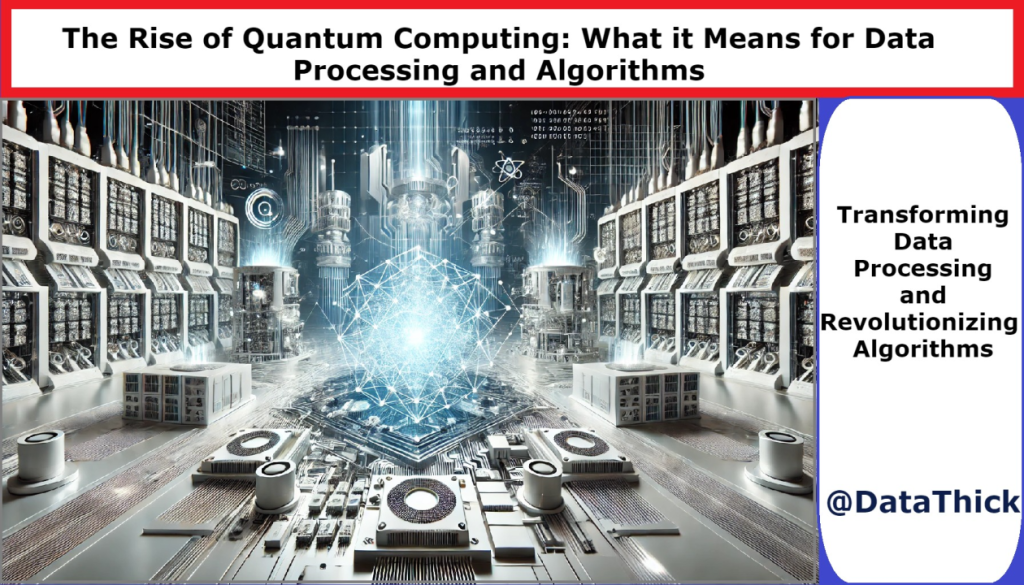
Current Developments
IBM is leading in quantum computing. They have built powerful quantum processors. Google is also a key player. They achieved quantum supremacy in 2019. Microsoft is developing its own quantum systems. Intel is working on quantum chips. Each of these companies is investing heavily in research.
Scientists have made many breakthroughs in recent years. Quantum entanglement has improved. This allows for faster data processing. Quantum error correction has also seen progress. This helps reduce errors in computations. Superconducting qubits are being enhanced. They are more stable than before. These advancements will improve data processing speeds.
Future Prospects
Quantum computing promises to change data processing with faster and more efficient calculations. This new technology could solve complex problems quickly, benefiting industries like healthcare and finance.
Potential Applications
Quantum computing can solve complex problems fast. It can help in drug discovery by finding better molecules. It might improve financial models, making predictions more accurate. It can help in climate modeling to predict weather patterns better. It could also enhance cybersecurity by creating stronger encryption methods. Quantum computers can optimize supply chains, making them more efficient.
Long-term Vision
Quantum computing will change many fields. It may lead to new scientific discoveries. It could transform artificial intelligence. AI might become smarter and more useful. Quantum computers could make data processing very fast. They might help in solving global problems. They could create new technologies we can’t imagine yet. The future looks bright with quantum computing.
Frequently Asked Questions
What Is Quantum Computing?
Quantum computing uses quantum bits, or qubits, for data processing. It leverages quantum mechanics to perform computations much faster than classical computers.
How Does Quantum Computing Work?
Quantum computing utilizes principles like superposition and entanglement. These principles allow qubits to perform multiple calculations simultaneously, vastly increasing computational power.
Why Is Quantum Computing Important?
Quantum computing can solve complex problems quickly. It has the potential to revolutionize fields like cryptography, materials science, and artificial intelligence.
What Are The Benefits Of Quantum Computing?
Quantum computing offers immense speed and efficiency. It can process large datasets and solve complex problems that are infeasible for classical computers.
Conclusion
Quantum computing holds great promise for data processing. It offers faster solutions. It can handle complex problems with ease. Traditional systems might struggle, but quantum computing thrives. Businesses and researchers will benefit greatly. This technology is still evolving. Exciting progress lies ahead.
So, stay informed and curious. Quantum computing could soon be a key part of our future. Embrace the change and explore the possibilities. Your data processing tasks may become more efficient and effective. Keep an eye on this fascinating field.