Not so long ago, “AI tools” was simply your e-mail shopper’s auto-completion. Come to think of it, it was not that long ago—perhaps 4 years ago. Now, they are preparing to draft legal documents, to program the production code at 2AM, and to sketch pictures from an incomplete sentence, which resemble photographs. However, today more than ever, tools are available.
It’s hard to keep up with the pace. However, the truth is that tools are more readily available than ever. Frequently the dread is greater than what actually occurs.
This guide will not sell you out. The six types and what they’re good for and where they still bite.
400M+ weekly users of ChatGPT. The value of the AI industry in the world is $200B. 77% of knowledge workers are using AI on a weekly basis.
Some numbers to spend some time with.
1. Conversational AI — the thinking partner
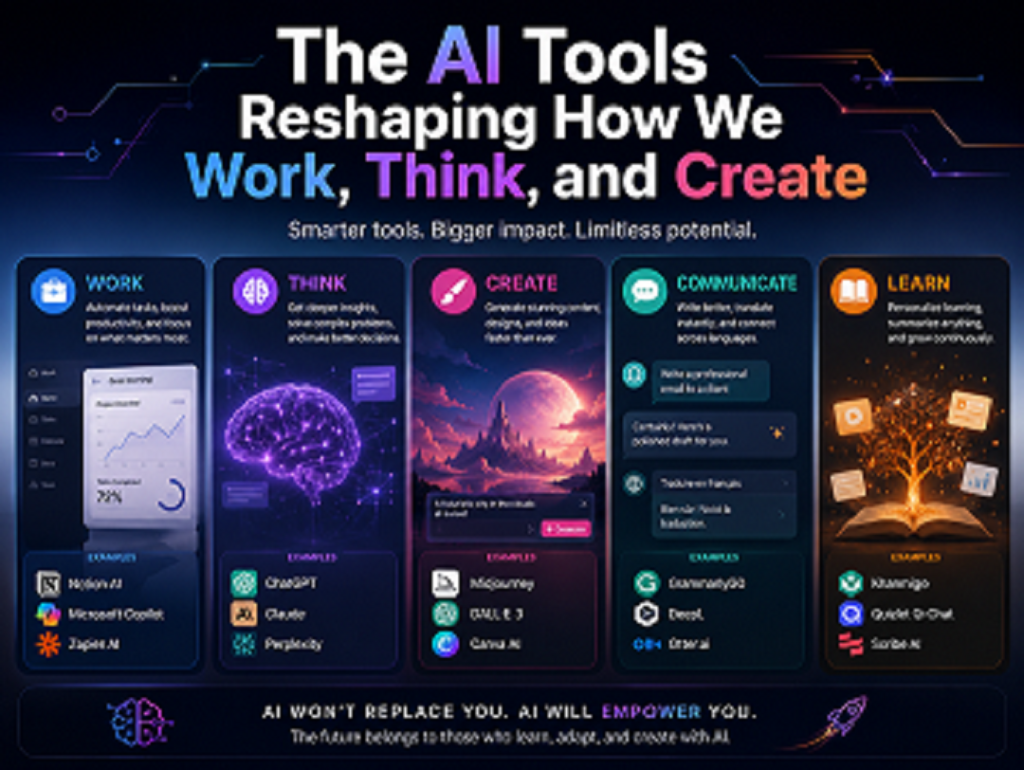
It’s a Swiss Army knife type. A chat interface opens, and all at once you can brainstorm product names, summarize a 50-page PDF, grapple with a particularly hard email, translate a contract, and sometimes more—all in the span of one afternoon. The household name, most people begin with ChatGPT. Claude (from Anthropic) is handling long, complex documents very well and is more careful and structured in its reasoning. If you are in the Google world, you will have the opportunity to use Gemini in Google Workspace.
People think that the choice of the model you go with matters more than it does. The important thing is to learn to prompt. Give context. Specify tone. Divide lengthy requests into smaller parts. The difference between a typist and knowing how to make a true work session. It is here that the lion’s share of productivity differences lies.
The best conversational AI tools are not a replacement for human judgment but an ability to greatly increase the speed of how you use human judgment.
2. AI writing tools — the content engine
Jasper, Copy.ai, Writesonic. These are more than just a simple chat interface: they have templates, brand voice controls, integrations, and workflows specifically designed for large-scale content creation. This is particularly helpful if you have a marketing team and are executing a number of campaigns simultaneously and need uniformity in all of them.
There is an exception to that, however: Any content will require a human editor. The tools are adept at structuring and quantizing your writing. A voice that’s all your own—original perspective, surprising insights. It’s not a criticism of the tools. That’s how it is these days.
3. AI image generators — visual ideas on demand
Nothing has been so captivating to the general public as this tool, and here’s why. You describe something. In exchange, you get an amazing photo. At times it is just so beautiful.
Midjourney delivers the most beautiful images, and there’s a reason designers and creative directors love it. For tasks where compositional precision is critical, DALL-E 3, integrated into ChatGPT, better adheres to specific text prompts. Stable Diffusion is free, open source, runs on your own machinery, and is extremely flexible for tech-savvy users.
The growth of technology is amazing. It was noticeable 2 years ago.
4. AI coding assistants—the developer’s co-pilot
Maybe this is where AI has achieved the most tangible and measurable success. 2021 was just the start of GitHub Copilot. Today, tools exist that can write whole functions from a comment, explain unfamiliar code bases, and catch bugs before software is released. Cursor is a fully AI-powered editor that’s quickly becoming popular. Cloud Code is like a terminating agent; it can automatically plan, write, and run code in an entire project.
Productivity gains of 30-50% for tasks have been shown. These numbers are real numbers. But it takes new skills, and they are real: reading AI-generated code with real skepticism when it is certainly wrong and knowing when to object. It is a critical eye that we don’t come with and that we have to learn.
5. AI research tools — smarter search
Traditional search gives you links. AI research tools give you answers synthesized and reasoned, with citations. Perplexity pioneered this: real-time web search combined with language model reasoning. You ask, and you get a coherent response with sources, not ten blue links to sift through yourself.
For academic and professional work, Elicit and Consensus go further—they’re built to interact with scientific literature specifically. Pull relevant papers. Extract findings. Surface where the research agrees and where it doesn’t. They are NOT repackaged search engines. They’re genuinely new instruments.
6. AI audio and video tools — the creative frontier
The fastest of all – by far. ElevenLabs can duplicate a voice from a brief sample and generate audio in numerous languages that sounds like a human speaking. Suno and Udio can create complete songs (lyrics, melody, instrumentation) within a minute of a text prompt. Just think on that for a moment.
Video has yet to catch up. Both Runway Gen-3 and Sora generate brief video snippets based on text prompts or images, but they’re not quite ready for prime time. However, it’s a high learning curve, and they are already usable for social content, explainers, or creative prototyping.
Conclusion—tools augment; humans decide
The key takeaway to grasp about AI tools in 2026 is that they are tools. Without a hammer, one can’t build a house. It allows the person holding it to construct quicker with less friction. Same principle here.
The folks working and making things today are not the ones who have abdicated their judgment to an algorithm. They’re the ones who learned to work together using AI’s speed and scope but bringing the imagination and the critical thinking and the lived experience that AI won’t have.
Choose one of the categories from this list. Spend a week and really get to know it. It may seem like there is a learning curve, but it is not as long as it appears. The pay-off on that investment is more than you could earn just about anywhere else you put the time.
FAQ
01 — Are AI tools safe to use with sensitive data? It depends on the tool and how it’s configured. Most major providers offer enterprise tiers where data isn’t used for training and is handled under stricter privacy terms. For genuinely sensitive data, look for on-premise or private cloud options, and read the data processing agreement before you start. That step matters.
02 — Will AI tools replace human jobs? The evidence so far points to task disruption more than role elimination. Routine, repetitive tasks are being automated. Roles requiring judgment, empathy, relationship-building, creative strategy—those are evolving rather than disappearing. The more practical concern isn’t being replaced by AI. It’s being outcompeted by someone who uses these tools and you don’t.
03 — Which AI tool is best for beginners? ChatGPT or Claude. Both have free tiers, intuitive interfaces, and broad capabilities. ChatGPT has the larger community and more tutorials floating around. Claude tends to handle complex topics with more nuance and structure. Try both for a week. You’ll know which one clicks.
04 — How do I get better results from AI tools? Prompt quality is almost everything. Be specific. Provide context. Specify format. Give examples of what good output looks like. And when the first response misses, iterate. Ask for a revision rather than starting over. Treat it like a conversation with a capable colleague, not a search query. That shift in framing changes how you use these tools entirely.
05 — Are there free AI tools worth using? Yes, genuinely. Claude, ChatGPT, Gemini, and Perplexity all have free tiers that cover most everyday use cases. Stable Diffusion is fully free for image generation. GitHub Copilot has a free individual tier. You can build a powerful AI workflow today without spending anything. That’s remarkable, actually.
06 — How do I know if AI-generated content is accurate? You verify it. That’s the short answer. AI language models can produce fluent, confident-sounding text that is factually wrong—this is called “hallucination,” and it’s a real limitation. For anything that matters, trace it back to the primary source. Perplexity and similar tools cite their sources, which makes this easier. But the verification step is always yours. AI gives you a draft. Your judgment is what makes it trustworthy.