For decades, the narrative of human evolution has been a brutal one: Homo sapiens, the clever upstarts, ruthlessly displacing Neanderthals, the lumbering, brow-ridged “other.” But a 140,000-year-old skull, unearthed from Israel’s Skhul Cave nearly a century ago, is whispering a different tale – one of attraction, collaboration, and maybe even a little prehistoric romance.
This isn’t just a skull; it’s a snapshot of a forbidden love affair frozen in time. Professor Israel Hershkovitz, the director of excavations at Skhul, paints a picture of a world where early humans and Neanderthals weren’t locked in a death struggle, but instead, were swapping spit (and genes) with gusto.
The story begins in 1932, when archaeologists Theodore McCown and Arthur Keith stumbled upon the remains of a child, around five years old, buried in the Skhul Cave. But the child’s skull was… perplexing. It possessed the rounded dome of a Homo sapiens, but its lower jaw and inner ear echoed with Neanderthal ancestry. Baffled, they neatly sidestepped the conundrum by classifying it as a whole new species: Palaeoanthropus palestinus.
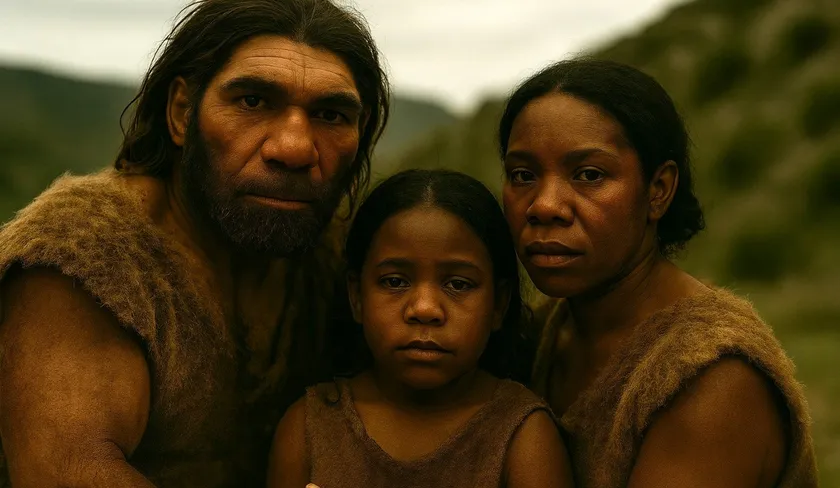
Now, almost a century later, Hershkovitz and his team are boldly re-writing that narrative. Their analysis, published in L’Anthropologie, argues that “Little Palestinian” wasn’t a new species at all. It was a hybrid, a love child from a Homo sapiens-Neanderthal union.
This discovery shakes the very foundation of our understanding of early human interactions. For years, Neanderthals were relegated to the role of simpletons, destined for extinction at our hands. But the Skhul child provides solid evidence of something far more nuanced: intimate relationships, perhaps even families, blurring the lines between species.
The Levant, modern-day Israel, it turns out, was a melting pot. While some early humans ventured into Eurasia, evolving into distinct Neanderthal and Denisovan populations, others lingered in this fertile region. With its mild climate, abundant megafauna, and relative geological stability, the Levant offered a welcoming home for these pre-Neanderthals, who Hershkovitz calls “the indigenous people.”
But then, Homo sapiens arrived, and the dynamics shifted. Three waves of migration out of Africa brought our species into contact with these pre-Neanderthals. And something happened. Instead of immediate conflict, there was… attraction?
“There was something about them,” Hershkovitz muses, his voice tinged with romantic speculation. “They seem to have always stirred our passions.”
Perhaps it was the rugged charm of the Neanderthals, or the exotic allure of the newly arrived Homo sapiens. Whatever the reason, these encounters resulted in a genetic blend, a fusion of traits that would shape the future of both species. The Skhul child is a tangible representation of this ancient mingling, a testament to the possibility that cooperation and connection were just as vital to our survival as competition.
And it wasn’t just genes that were exchanged. The Skhul remains are accompanied by evidence of cultural exchange. Homo sapiens introduced the Mousterian stone tool technology, a significant upgrade from the Neanderthals’ Yabrudian methods, a change so radical Hershkovitz likens the shift to trading a buggy for a Mercedes.
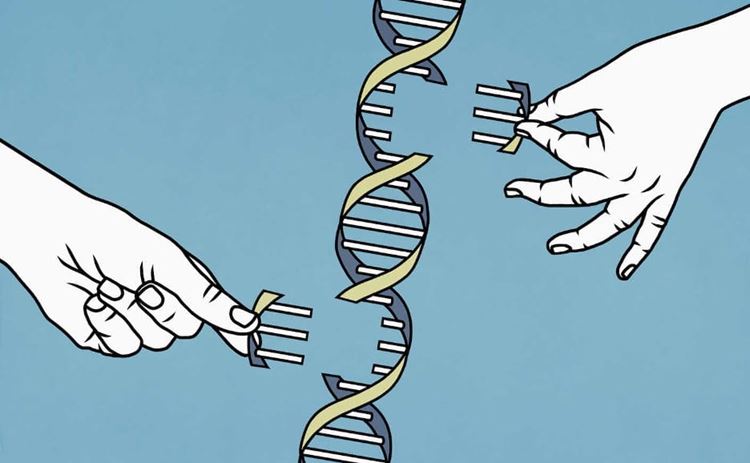
So, what happened next? Around 70,000 years ago, another migration brought Homo sapiens into contact with Neanderthals, leading to the interbreeding event that left its mark on the DNA of all non-Africans today. While the populations of the Levant vanished for a while, a new breed emerged, carrying the legacy of both Homo sapiens and Neanderthal, a testament to the power of connection and the complex tapestry of our shared ancestry.
Hershkovitz challenges the traditional narrative of aggressive dominance, suggesting that Homo sapiens charmed their way to the top. We became more social, forming larger groups, and perhaps, in the process, absorbing the smaller, less cohesive Neanderthal communities.
The story of the Skhul child isn’t just about bones and skulls; it’s about rewriting our own origin story. It’s about recognizing that our ancestors weren’t just cold-blooded competitors, but complex beings capable of empathy, cooperation, and even love. It’s a reminder that the lines between species aren’t always so clear, and that sometimes, the most profound changes come from embracing the “other.” Perhaps the secret to our success lies not in our dominance, but in our capacity for connection. And maybe, just maybe, our inner Neanderthal isn’t a savage brute, but a partner in a beautiful, ancient dance of evolution.