



5 Foods That Actually Help You Build Stronger, Leaner Arms
Let’s be honest about something first. You can’t spot-reduce fat from one specific part of your body. No food and no exercise will exclusively burn arm fat while leaving everything else untouched. That’s just not how the body works.
What you can do is build muscle in your arms while reducing overall body fat — and the food you eat plays a significant role in both. Not through restriction or complicated protocols. Through consistent, well-chosen nutrition that supports muscle repair, keeps you full, and gives your body what it needs to change over time.
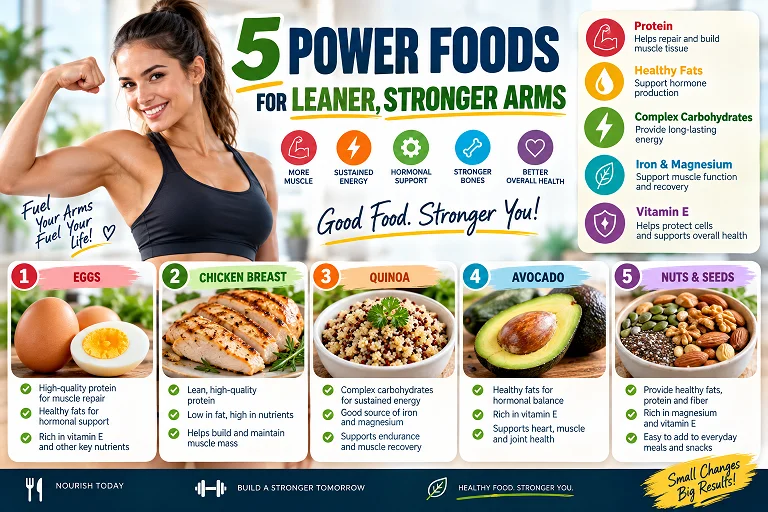
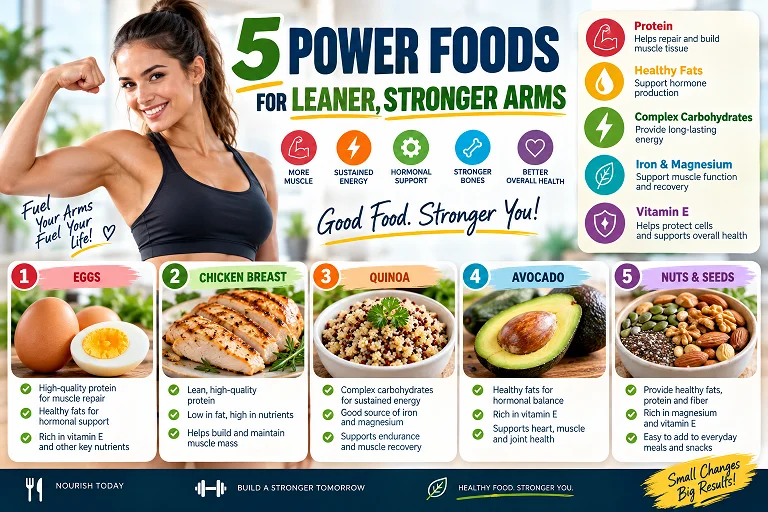
These five foods do that reliably, affordably, and without requiring you to overhaul everything at once.
1. Eggs
Eggs are about as close to a complete food as you can get. Each one contains all nine essential amino acids — the building blocks your muscles need to repair themselves after exercise. They’re particularly high in leucine, an amino acid that plays a direct role in triggering muscle protein synthesis. That’s the process your body uses to actually build new muscle tissue.
What makes eggs especially useful is the combination they offer. High-quality protein, healthy fats, vitamins, and minerals — all in something that costs very little and takes five minutes to cook. They’re also genuinely filling, which matters if you’re trying to manage overall calorie intake without feeling deprived.
Boiled or poached are the better preparation methods if you’re eating them regularly. Not because fried eggs are terrible, but because you avoid adding unnecessary calories from oil or butter on top of an already calorie-efficient food.

2. Chickpeas
Chickpeas don’t get nearly enough credit. One cup of cooked chickpeas gives you around 15 grams of plant-based protein, a meaningful amount of fiber, complex carbohydrates, iron, and magnesium. That’s a lot of nutritional work from something that costs next to nothing.
The protein and slow-digesting carbs work together in a useful way. You get a steady release of energy rather than a spike and crash, which supports sustained performance during workouts and helps with recovery afterward. The fiber keeps you full. The iron supports oxygen delivery to working muscles—something that matters more than most people realize when it comes to training capacity and fatigue.
They’re easy to use, too. Toss them into a salad, mash them into a wrap, blend them into hummus, or eat them warm with spices as a side. There’s no complicated preparation involved.
3. Almonds
A small handful of almonds — around 20 to 25 — delivers protein, fiber, healthy unsaturated fats, magnesium, and vitamin E. Each of those things pulls its weight here. The fats and fiber keep hunger in check. Magnesium helps the body convert carbohydrates and fats into usable energy, which becomes particularly important during exercise. Vitamin E is an antioxidant that supports muscle recovery after training.
The one thing worth saying about almonds is portion size. They’re calorie-dense, which isn’t a bad thing, but it’s easy to eat twice as many as you intended. A small handful is enough to get the benefits. You don’t need to eat them by the bagful for them to do something useful.

4. Lean Chicken
Chicken breast is the most straightforward protein source on this list. A 100-gram serving of cooked chicken breast contains roughly 31 grams of protein — high quality, complete, and with minimal fat. For anyone doing regular strength training, that kind of protein intake after a session makes a real difference to how quickly the muscles repair and adapt.
Beyond the protein count, chicken is also a solid source of B vitamins, particularly B3 and B6. These are involved in converting the food you eat into energy — which is what fuels your workouts in the first place.
Grilled or baked is the way to go for everyday eating. It keeps the fat content low and the protein density high. If you find plain chicken boring, that’s a seasoning and cooking method problem, not a chicken problem. A decent marinade changes everything.

5. Spinach
The Popeye association is a bit of a cliché, but it’s not entirely wrong. Spinach contains plant compounds called phytoecdysteroids—specifically ecdysterone—that some research suggests may support muscle protein synthesis. It also contains nitrates, which help improve blood flow and oxygen delivery to muscles during exercise.
More practically, spinach is rich in iron. Iron is essential for carrying oxygen in the blood, and without enough of it, muscles fatigue faster and recovery slows down. Many people — particularly women — are mildly iron deficient without realizing it, and adding spinach regularly to meals is one of the easier ways to address that.
It’s also one of the most versatile vegetables going. Raw in salads, wilted into pasta, blended into a smoothie where you can barely taste it, sautéed with garlic as a side — there’s very little it doesn’t work in.
Conclusion
None of these foods are exotic or expensive. They’re all things you can find in any supermarket and fit into meals you’re probably already making in some form.
The bigger picture here is consistency. Eating eggs occasionally and expecting toned arms isn’t realistic. But eating well — enough protein, enough fiber, enough micronutrients — consistently over weeks and months, combined with regular upper-body exercise, genuinely changes how your arms look and feel. The food doesn’t do the work alone. Neither does the exercise. They work together, and these five foods are a solid foundation to build that combination on.
Disclaimer
This article is for general informational and educational purposes only. It is not intended as medical, nutritional, or fitness advice. No food can target fat loss in a specific area of the body. Individual results vary based on genetics, overall diet, exercise habits, and other health factors. If you have any medical condition, dietary restriction, or specific health goal, please consult a qualified healthcare provider or registered dietitian before making significant changes to your diet or exercise routine.
FAQ
Sources

Health & Wellness Writer | Research-Informed Health Content Creator
A.K.M. Monjurul Hoque is a health and wellness writer specializing in health, beauty, fitness, nutrition and healthy living. His content is informed by health journals, books, seminars, training programs, and discussions with experienced healthcare professionals. He writes clear, practical and research-informed articles for general education and encourages readers to seek personalized advice from qualified medical professionals.