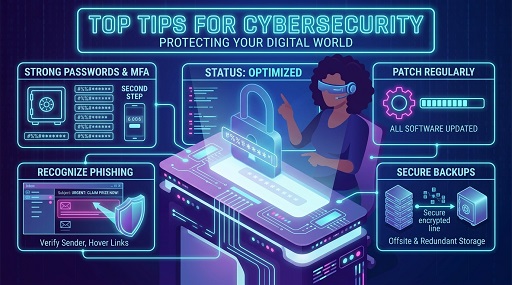
It seems like this happens every morning you check your email, or while you’re drinking your coffee—you receive a notice from a business that seems legit on a form that looks legitimate: a shipping confirmation, an account alert, a reminder that your password is soon to expire. You click. After 30 seconds, it is “your device” no longer. It occurs daily with smart, careful individuals, and this is the reason that cybersecurity can no longer be considered an after-thought.
Our online habits of banking, working, shopping, and socializing have created an online presence that is equally as important – and exposed – as our in-person presence. The good news? Being an IT professional doesn’t help to be safe. Several simple behaviors can keep most attacks at bay. Here’s a no-nonsense resource for staying safe, secure and secure on the web.
The Need for Cybersecurity has Never been greater
Cybercrime is no longer a distant intangible threat; today it is a realistic and tangible danger. Ransomware attacks, data breaches and identity theft top headlines every week; in fact small business and individuals are becoming the target of attacks, as they are the least protected. The U.S. Cybersecurity and Infrastructure Security Agency (CISA) says that most often, attackers target the simple security weaknesses – weak passwords, unpatched software, human fallibilities, or a combination of these. That is, the majority of breaches can be avoided.
1.Create Strong Passwords as well as Keep Them Alive
One of the more frequent means of intrusion is with weak and compromised passwords. If you reused your password in an older forgotten account, a breach of that account could result in your email account, banking information and social media becoming accessible.
What to do instead:
- Have a different password for all accounts — none at all.
- Use 12–16 characters, with a combination of words, numbers and symbols which are easy to remember but hard to guess.
- Consider using a password manager (such as Bitwarden, 1Password, or your web browser’s password manager) to avoid remembering a dozen or more longer passwords.
- Do not keep passwords in text file, or on a sticky note hanging on your monitor.
Newly recommended by the National Institute of Standards and Technology (NIST), long, easy-to-remember passphrases are more favored than short, complex passphrases that are more likely to be written down or forgotten.
2.Turn On Multi-Factor Authentication (MFA)
Even with a good password, the account information may be compromised during a data breach or using a phishing attack. With multi-factor authentication, an additional step, like a code sent to your phone, fingerprint, or authenticator app, prohibits login with a stolen password.
Enable MFA on:
- Email accounts your most vital account, as you can reset everything with it)
- Applications relating to banking and finance.
- Social Media Cloud Storage
- No work accounts or VPNs
If you use authenticator apps (such as Google Authenticator or Authy) to instead of SMS codes, select the app—SMS can be intercepted through SIM-swapping scams.
3.Ensure the software and devices are up to date
Whenever you click on “update available” you are discarding a possible open door. Security weaknesses are often plugged in software patches that hackers are constantly looking for and exploiting.
- Have auto-updates enabled for operating system, browser and apps.
- Do not neglect firmware updates to routers, smart home devices and IoT gadgets, which are being targeted more and more often.
- Phase out software and devices that are no longer supported by manufacturer as there is no longer any security patching for them.
4.Understand How to Identify Phishing Emails
Phishing is the top vehicle for malware and credential theft because it has little to nothing to do with technology – but everything to do with human trust. FTC advises that phishing emails generally instill a sense of urgency, enticing you to take action without careful consideration.
Be aware of any of the following red flags:
- Email messages from unexpected or unknown senders
- Urgent or threatening language (Your account will be suspended in 24 hours)
- Hello, or generic greetings rather than first name
- Links that do not match its actual website address on mouseover (hovering over with your mouse).
- Forms that ask for passwords, payment information or gift cards
If in any doubt, don’t click! Avoid following links in an email or text message program to the company’s official website or app.
5.Undertake 5. Secure Your Home and Business Network
Your router is the gateway to all of the devices in your home or office. It is the same as if a door was left unlocked if it is kept in its default value.
- Update the default username and password of your router.
- Opt for WPA3 encryption for your WIFI (at least WPA2).
- Create a guest network for visitors and smart home devices.
- Easy to choose a software VPN which encrypts you while you are traveling around on a public wi-fi.
6.Back up data regularly
Ransomware attacks affect you by blocking access to your files until you pay the ransom! With a solid backup strategy, there’s no leverage at all.
Stick with the time honored 3-2-1 rule:
- 3 copies of your data
- 2 different storage types (e.g., external hard drive and cloud storage)
- 1 copy retained offsite or offline
Test your backups regularly, a backup that you cannot restore from is a backup that doesn’t exist.
7.Let’s do the Principle of Least Privilege
In many cases, all accounts, apps and users don’t require access to all information. If one login is compromised, then it will be less harmful.
- Run computer programs on a standard (non-admin) user account.
- Check apps permissions on mobile frequently and Deny any inappropriate access.
- Within an enterprise environment, provide employees access to only those systems and data that they need to perform their duties.
8.Install and maintain a reputable security program
A good anti-virus or endpoint protection software can go a long way in providing protection since it will detect the malware before it infects your network.
- Use reliable, highly rated security software instead of free security software from an unrecognized site.
- Allow real-time scanning and automatic updates to the definitions.
- If your business is, try endpoint detection and response (EDR) for more advanced threat monitoring.
9.Humans are the True Firewall – Train Your Team.
Technologies are not adequate at all for businesses – the majority of breaches are attributed to human error. Practical security awareness training ensures that your staff is in the line of defense, rather than your weakest link!
- Conduct phishing campaigns periodically.
- Avoid training that is long, ad hoc, and a once-a-year slideshow.
- Establish a clear and non-confrontational report process for reporting suspicious activity.
10.One thing with good defense is never 100% breach-proof
It is found that in the first hour following an incident, those responders who are knowledgeable of exactly what to do can dramatically limit the damage.
A simple layout would be to include:
- Specification of any individuals to be notified immediately (IT, leadership, possibly legal counsel)
- How to remove impacted devices from network
- How and when to communicate with customers or employees, if needed
- Steps to take to report the incident to authorities
Extranal Links
Conclusion
It is not a question of does a web page exist that is “hacker-proof” — it is a question of piling enough good habits, so that it is more unappealing to move your efforts to the next web page or business. You can cope with the vast majority of real-world threats with strong, unique passwords, multifactor authentication, frequent changes, a healthy dose of skepticism towards unsolicited messages and reliable backups.
Don’t feel like doing too much: choose 2 – 3 tips from this list and implement them over the next week. Security is a process; it’s not something that can be patched up quickly, and every subsequent level made your digital world a little safer.