
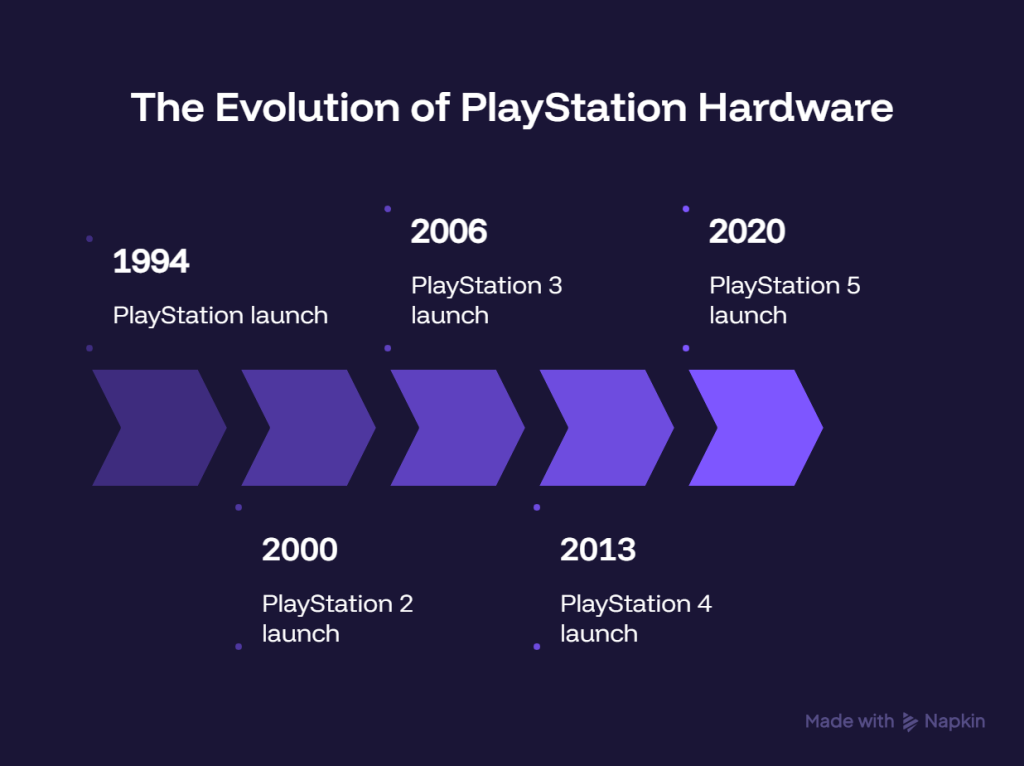
Since its debut in 1994, Sony’s PlayStation has delivered groundbreaking hardware to the gaming industry that has redefined the console gaming experience. From the original PlayStation to the cutting-edge PlayStation 5, each generation has brought innovations that have pushed the boundaries of technology and redefined entertainment. Let’s take a look at the evolution of PlayStation hardware, its key features, and its impact on gaming culture.
Evolution of PlayStation Hardware explains the history of PlayStation hardware from the PS4 onwards
1.The first game console to hit the market that was released on CD-ROM is the 32-Bit Revolution PlayStation (PS1).
The original PlayStation, which was released in December 1994, ushered in 3D polygonal graphics, a new frontier in video game visuals. Some of the major hardware specifications were:
- 32 bit RISC processor provided good 3D rendering.
- CD-ROM Drive: allowed larger game files and better quality of sound than cartridges.
- Memory cards: Portability of the save data was added.
The PlayStation’s hardware design, along with classic games
2. PlayStation 2 (PS2): A Multimedia Powerhouse
The PS2, which came out in 2000, is the top-selling console and has sold more than 155 million games. It followed on the heels of its predecessor and expanded on its success with:
- Emotion Engine CPU: improved graphics quality and realism.
- Doubled DVD playback – as home entertainment device, in order to enhance the appeal.
- Backward compatibility: Users were able to play PS1 games, a trend that would be followed by future consoles.
Thanks to its hardware capabilities, the PS2 allowed classics such as Shadow of the Colossus and Grand Theft Auto: San Andreas to flourish and thus secure its reputation.
3.PlayStation 3 (PS3): A Leap to High Definition
In 2006, the PlayStation 3 was launched with high-definition gaming and multimedia features:
- Cell Broadband Engine: provided unprecedented processing power, but was difficult for developers.
- Blu-ray disc drive: 1 disc could hold more HD movies and game files.
- Wi-Fi and HDMI support: modernized connectivity for a seamless gaming experience.
The PS3 had some rocky starts, particularly because of its high price tag, but it eventually picked up steam with games like Uncharted 2: Among Thieves and The Last of Us.
4. PlayStation 4 (PS4), Accessible Power
The PS4, which came out in 2013, emphasized user friendly development and improved social functions. Highlights include:
- x86-64 AMD “Jaguar” CPU: Simplified game development.
- 8GB GDDR5 RAM: Ensured fast performance for graphically intense games.
- DualShock 4 controller: First controller with a touchpad and improved ergonomics.
The PS4 was a favourite with gamers and became the best-selling console with a huge library of titles like God of War and Horizon Zero Dawn, selling more than 117 million units.
5. PS5 – Next-Gen Experience
The PS5 is a new console that was released by Sony in 2020 and is equipped with the latest technology for an immersive gaming experience.
- Custom AMD Zen 2 CPU and RDNA 2 GPU: Support ray tracing and 60 FPS 4K gaming.
- With ultra-high speed SSD, load time is virtually eliminated!
- DualSense controller: New haptic feedback and adaptive triggers for an immersive experience.
- 3D audio: adds depth and dimension to the soundscapes for an immersive experience.
The PS5’s hardware is designed for the likes of Demon’s Souls and Spider-Man: Miles Morales, and represents the future of gaming.
The Peculiar Things
The PlayStation peripherals go beyond the consoles themselves, with a robust peripheral lineup:
- Controllers: DualShock to DualSense, the inventive controller.
- VR systems: PlayStation VR and the upcoming PS VR2 offer immersive VR experiences.
- External Storage: Allows for greater games.
- Media remotes and headsets: enhance multimedia functionality and communication.
These peripherals will keep PlayStations versatile entertainment devices.
The PlayStation Hardware and its impact.
In the world of gaming, PlayStation has been a game-changer in many ways:
- Advanced graphics, quicker loading speeds, and immersive audio define user experiences, as technological breakthroughs take the stage.
- Iconic franchises, such as Final Fantasy and The Last of Us, have made indelible marks on pop culture under the influence of culture.
- IIndustry trends: Backward compatibility, online integration, and VR implementation have impacted the gaming industry as a whole.
So what will happen next to PS Hardware?
Sony will probably look into innovations in cloud gaming, AI-driven experiences and even more immersive hardware as the gaming world continues to evolve. As the PlayStation ecosystem boasts a strong legacy and cutting-edge design, it is poised to spearhead the next generation of gaming evolution.
Internal Links
- Top Gaming Accessories for PlayStation Players in 2026
- Best PlayStation Exclusive Games You Should Play
External Links
Conclusion
From one generation to the next, PlayStation hardware has set the bar high for gaming technology, constantly outdoing itself in delighting players with new and extraordinary experiences. Sony has a history of innovation, accessibility, and excellence, starting from the PS1 and going all the way up to the PS5. With the brand constantly pushing the envelope, the future of gaming is looking brighter than ever.
Your article helped me a lot, is there any more related content? Thanks!