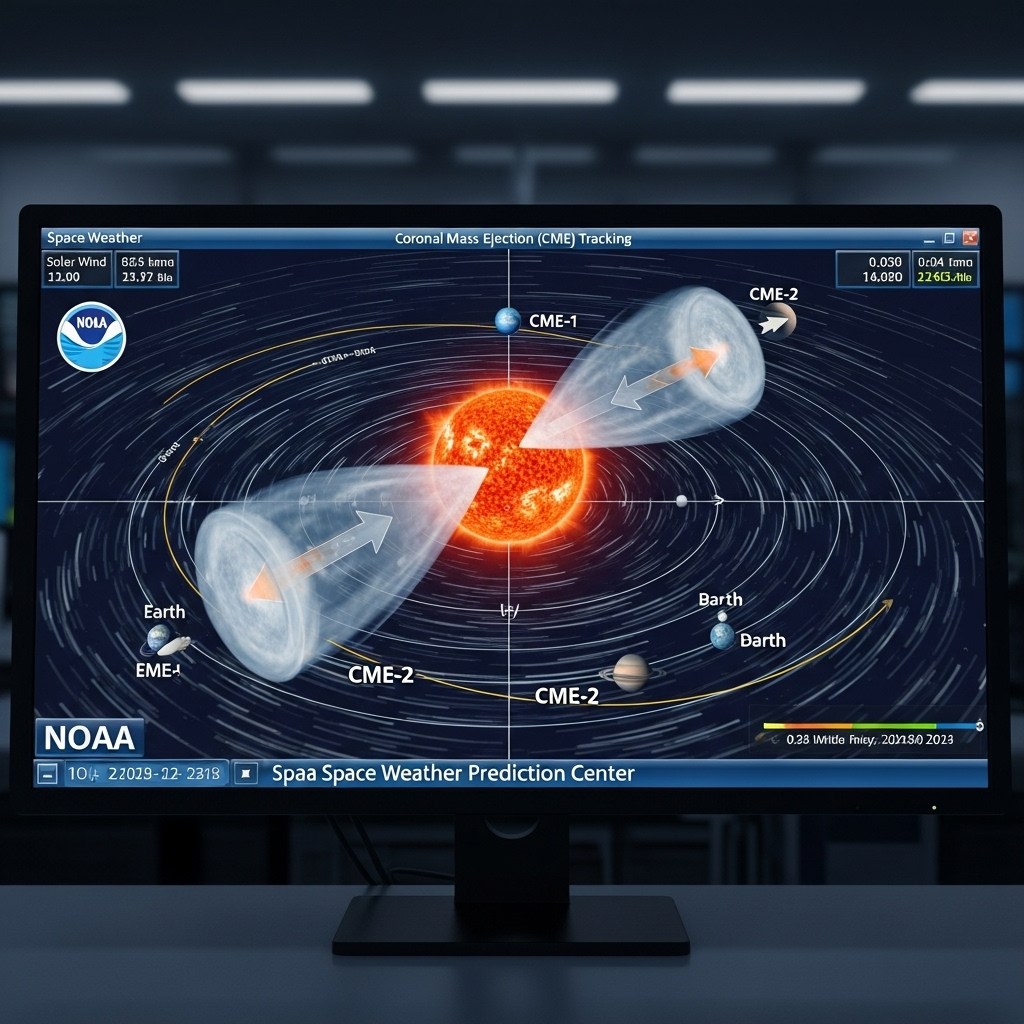
Get your cameras and your sense of wonder ready, because the sun is sending a spectacular light show our way! A series of powerful solar eruptions are currently interacting with Earth, creating the potential for stunning Northern Lights displays for many who don’t normally see them.[1][2][3]
What’s Happening Above Us?
In simple terms, the sun has been very active lately. Over the past few days, it has released several powerful bursts of energy and particles, known as Coronal Mass Ejections (CMEs).[4][5] These massive clouds of supercharged solar material have been traveling through space and are now arriving at our planet, interacting with Earth’s magnetic field.[1][6]
This interaction is what triggers a geomagnetic storm. Think of it as our planet’s magnetic shield getting rattled, causing the particles to zip towards the North and South Poles. As these particles collide with gases in our atmosphere, they create the beautiful, dancing ribbons of light we know as the aurora, or the Northern and Southern Lights.[7][8]
The “Cannibal CME” and a G3 “Strong” Storm
What makes this event particularly exciting is the possibility of what scientists playfully call a “cannibal CME.” This happens when a faster-moving CME overtakes and “swallows” a slower one that was launched earlier.[5][9][10][11][12] This combination can create a larger, more complex plasma wave that can trigger a more powerful geomagnetic storm when it reaches Earth.[10]
Because of these combined impacts, the National Oceanic and Atmospheric Administration (NOAA) has issued a watch for a G3 “Strong” geomagnetic storm.[1][13][14] While this might sound alarming, for most of us, it’s a reason to look up at the night sky.
Where and When to See the Northern Lights
With a G3 storm in effect, the aurora could be visible much farther south than usual.[13][15] Stargazers in the northern United States, potentially as far south as Oregon, Iowa, and Pennsylvania, may get a chance to see the celestial display.[5][13] Of course, the view will be even better in more northern latitudes like Alaska, Canada, and the northernmost U.S. states.[1][3][13]
Here are some tips to increase your chances of seeing the show:
- Best Time: The most intense activity is often between 10 p.m. and 2 a.m. local time.[16][17]
- Find a Dark Spot: Get as far away from city lights as you can. Light pollution will wash out the aurora.[1][15][16]
- Look North: Find a spot with an unobstructed view of the northern horizon. The lights often start as a faint glow low on the horizon.[15][16]
- Check the Forecast: Keep an eye on weather forecasts for clear skies and aurora forecasts from sources like NOAA’s Space Weather Prediction Center.[15][18]
- Be Patient: The aurora can ebb and flow, so give your eyes time to adjust to the darkness and be prepared to wait.
While a bright moon can sometimes make the lights harder to see, a strong storm like this can still put on a brilliant display.[2][16]
Are Solar Storms Dangerous?
For people on the ground, solar storms are not directly harmful. Our planet’s atmosphere and magnetic field do an excellent job of protecting us.[19] However, strong geomagnetic storms can potentially disrupt satellites, GPS navigation, and radio communications.[6][7][20] In very rare and extreme cases, they can even affect power grids.[6][21]
Conclusion: A Cosmic Treat
This solar event is a fantastic reminder of the dynamic and powerful connection between the sun and our planet. While space weather experts monitor for any potential technological disruptions, the rest of us have a unique opportunity to witness one of nature’s most breathtaking spectacles. So, if you have clear skies over the next couple of nights, be sure to step outside, look north, and you might just catch a truly unforgettable cosmic dance.
Frequently Asked Questions (FAQ)
Q1: What is a solar storm?
A solar storm is a disturbance on the sun that can send bursts of energy and particles toward Earth. The most significant are solar flares (intense bursts of radiation) and Coronal Mass Ejections (CMEs), which are massive clouds of solar plasma.[19][21]
Q2: What causes the Northern Lights (aurora)?
The Northern Lights are created when charged particles from the sun, carried by the solar wind, collide with gases in Earth’s upper atmosphere. These collisions excite the gas molecules, causing them to glow in different colors, most commonly green, but also pink, purple, and red.[7][8]
Q3: What does the “G-Scale” for geomagnetic storms mean?
The G-Scale is a way to measure the intensity of a geomagnetic storm, ranging from G1 (Minor) to G5 (Extreme). A G3 “Strong” storm, like the one currently predicted, has the potential to create auroras visible at lower latitudes and can cause some issues with satellite navigation and power systems.[15][20]
Q4: Is a “cannibal CME” a real scientific term?
While it sounds dramatic, “cannibal CME” is a term used by scientists to describe a real phenomenon where a fast-moving Coronal Mass Ejection overtakes and merges with a slower one in front of it, creating a larger, more potent solar eruption.[9][10][11]
Q5: How can I take photos of the aurora with my phone?
Many modern smartphones are capable of capturing the Northern Lights. Use your phone’s “Night Mode” or a pro mode that allows you to set a long exposure time (a few seconds). It’s crucial to keep your phone as steady as possible, so using a tripod is highly recommended for the best results.[1]
Sourceshelp