




The Complete Guide to Collagen Benefits: What Science Actually Says
Health & Wellness · May 2026

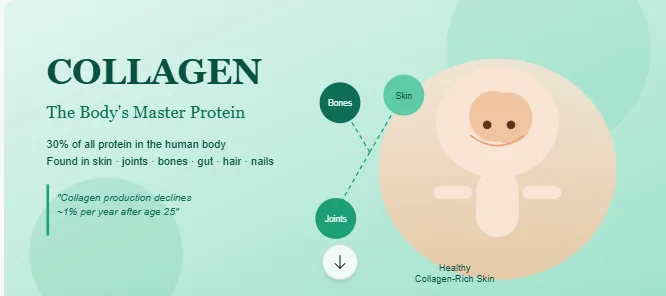
Collagen is found throughout the body — in skin, joints, bones, muscles, and more.
What is collagen?
Collagen is a structural protein that acts like the scaffolding of your body. It forms a mesh-like network that gives skin its firmness, provides cushioning in joints, and gives bones their flexibility so they don’t shatter on impact. There are at least 28 different types of collagen, but Types I, II, and III account for the vast majority found in the human body.
Here’s the challenge: your body’s natural collagen production begins declining as early as your mid-20s, and by your 40s and 50s, the effects can become quite visible—looser skin, stiffer joints, and slower recovery from exercise. This is what makes understanding collagen — and how to support it — so important.
| 30% of all body protein is collagen | 28 known types of collagen | ~1% annual decline after age 25 | 70% of skin’s dry weight is collagen |
Top science-backed benefits of collagen
| Skin elasticity & hydration Studies show collagen peptide supplementation can significantly improve skin elasticity and reduce the appearance of wrinkles in as little as 8–12 weeks. | Joint health & mobility Collagen makes up cartilage tissue. Supplementation has been shown to reduce joint pain and stiffness, particularly in people with osteoarthritis. | Bone density support Collagen gives bones their flexible structure. Research suggests it may help slow the breakdown of bone protein and support overall bone mineral density. |
| Muscle mass & strength Collagen is a component of muscle tissue. Some research suggests it may help increase muscle mass and strength, especially in older adults and during exercise. | Heart health Collagen provides structure to your arteries. Without enough of it, arteries can become less flexible and fragile—potentially contributing to cardiovascular risk. | Gut lining integrity Collagen is a key component of connective tissue in the gut lining. Supporters of “leaky gut” protocols frequently cite collagen as a healing nutrient. |
Collagen and skin: a deeper look
Of all collagen’s benefits, its effect on skin is perhaps the most studied. Skin is composed of roughly 70% collagen (by dry weight), which is responsible for its structure, firmness, and ability to bounce back after being stretched. As we age and collagen levels fall, the skin’s inner layer thins and loses elasticity—resulting in fine lines, sagging, and a rougher texture.
Multiple randomized controlled trials have found that oral collagen peptide supplementation—typically 2.5 to 10 grams per day—improves skin hydration and elasticity and reduces the depth of wrinkles compared to placebo groups. Vitamin C plays a critical co-factor role here, as it is essential for collagen synthesis. This is why many collagen supplements include added vitamin C.
How to naturally boost collagen production
Your body synthesizes collagen from amino acids — primarily glycine, proline, and hydroxyproline. The following strategies can support healthy collagen production:
Eat collagen-rich foods. Bone broth, chicken skin, fish skin, and egg whites are all rich in collagen or the amino acids needed to produce it. Citrus fruits, berries, garlic, and leafy greens support synthesis by supplying vitamin C, zinc, and copper.
Limit collagen-damaging habits. UV radiation, cigarette smoke, excessive sugar, and chronic stress are all proven to degrade collagen faster. Using SPF daily and managing stress go a long way.
Consider supplementation. Hydrolyzed collagen (collagen peptides) is the most bioavailable supplemental form. The small peptide chains are well-absorbed in the gut, and research suggests they signal fibroblast cells to produce more collagen.
Conclusion
Collagen is far more than a beauty buzzword. It is a foundational protein that touches nearly every system in your body — from the suppleness of your skin to the resilience of your bones and the comfort of your joints. While your body’s natural production declines with age, the good news is that targeted nutrition, smart lifestyle choices, and evidence-supported supplementation can meaningfully slow that decline.
Whether you begin with a daily bowl of bone broth, a collagen peptide powder, or simply protecting your skin from sun damage—any step toward supporting your collagen is a step toward healthier aging. The science is compelling, and the barriers to getting started are low. Lorem ipsum dolor sit amet, consectetur adipiscing elit. Ut elit tellus, luctus nec ullamcorper mattis, pulvinar dapibus leo.
Frequently asked questions
When should I start taking collagen?
How long does it take to see results from collagen supplements?
Is marine collagen better than bovine collagen?
Can vegans get collagen benefits?
Are there any side effects of collagen supplements?
This article is for informational purposes only and does not constitute medical advice.


Health & Wellness Writer | Research-Informed Health Content Creator
A.K.M. Monjurul Hoque is a health and wellness writer specializing in health, beauty, fitness, nutrition and healthy living. His content is informed by health journals, books, seminars, training programs, and discussions with experienced healthcare professionals. He writes clear, practical and research-informed articles for general education and encourages readers to seek personalized advice from qualified medical professionals.