Every year one of the channels is declared dead. Email is dying. SEO is over. The days of being profitable from Facebook advertisements have passed. But each year brands continue to use it because the reality is much less sexy and more helpful than the hot takes: digital marketing isn’t broken. The strategy is most of the time correct.
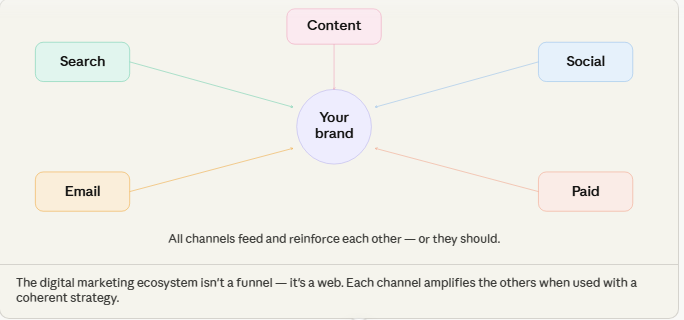
But here’s a shot at truth: This is what it looks like when it’s not a funnel — when attention is fragmented, attribution is fuzzy, and there’s a lot of room between what brands are saying and what people are hearing.
“An average person receives 4,000 to 10,000 messages daily for their brands – yours is one of them.”
That’s a number to contemplate. Don’t let it be an excuse to give up. It’s an argument for being truly different, which is more difficult than simply increasing advertising spend, but is the only thing that will succeed in the long run.
Your brand Search Social Email Paid Content all channels work together and reinforce each other — or they should.
The channels, without the spin
Search — intent on a platter
The only channel people come to wanting something is search. This is what makes it so special. It also gives it a competitive edge, which is almost unfair to smaller brands that are starting out from scratch. It takes a certain amount of time to build organic search presence – not weeks, real time – and the brands that have been creating quality content for five years are building a compounding advantage that is difficult to catch up with in a short period of time. Paid search fills in the middle, but there is a limit to paid search. Once you cease paying, the traffic ends up. No ownership, just renting.
Social media—conversation, not broadcast
Brands that are successful on the social landscape today are thinking conversation, not content calendar.They’re responding. They’re saying the not so comfortable. They are revealing that this is the true owner of the account. In the meantime, most brand pages are sharing pretty graphics in a vacuum that the algorithm designed and are wondering about the drop in engagement.
For years, the page reach for most of the large sites has declined. The latter isn’t secret in the least. Don’t trick yourself by assuming that the algorithm will shift in your favor; factor it in to your plan.
Email — old, boring, still the best ROI
Why is it that email is still around despite all its death notices? You own the list. Those on it have volunteered. The ROI typically beats nearly all other digital channels and is thought to be approximately $36 per $1. Again, that’s not a definite number, but one thing is for sure: a warm, opted-in audience is rare and valuable.
The caveat is that your subject line is fighting against 50 other subject lines. If it’s in the inbox, open it up for a purpose.
Content marketing — the slow burn that compounds
But, unlike advertisements, good content can accomplish something that ads can’t: trust building before someone is ready to purchase. The blog reader who had been reading your content for six months prior to when he or she needed your product is different from the prospect who saw your retraining ad at just the right moment. Both convert. Only one is a loyal customer?
Hence the underfunding of content. That is, it will and will be returned, albeit a little bit late, and quarterly reporting doesn’t tolerate tardiness.
| Email ROI $36 per $1 spent (avg) | SEO leads’ close rate 14.6% vs 1.7% outbound | Video influence 89% say video influenced a buy | Content marketing cost 62% less than outbound |
The part nobody talks about enough: data literacy
For most marketing teams, too much data leads to a lack of insight. All the dashboards are full up and not useful. These reports are very extensive. But when it comes time for a true decision, the discussion always comes back to gut feel.
The marketers that really make the difference have a special habit; they ask what would change their mind. This sounds basic. It’s hardly ever done.
You don’t need more complicated data; you need a clearer question.
The value of using paralytics tools is based on the questions one brings to the tool. No matter if you’re in GA4, Meta Ads Manager, or any other CRM, they are not going to tell you why it worked or failed. You’re going to have to do your job. The tool provides you the “what,” and you have to determine the “why.”
AI in digital marketing — where it actually helps
It’s a noisy place here. A few things that are actually true: AI tools have become significantly better in terms of first drafts, variations of ad copy, data pattern recognition, and keyword clustering. They lack strategic and judgmental skills and don’t know what works on an emotional level. That gap matters.
The real-world implication: Invest the time saved by using AI on the thinking, and use AI to go faster on the mechanics. The faster without the thought, the more mediocre content, faster.
Conclusion
This is because digital marketing in 2026 isn’t more challenging than it’s ever been but more sincere. However, the strategies that do work are the ones that have always been fundamentally correct: get to know your audience very well, be consistent in your appearance, provide something of value to your audience, and track what counts.
Noise has increased, and so true signals are better discernible than before. Companies that are prepared to say something authentic and make content that attracts attention, and are willing to work on relationships instead of conversions, are the ones that are likely to win over time—even if they can’t show it in a weekly report.