Neutrinos—often called the universe’s “ghost particles”—continue to puzzle scientists with their near-light-speed travel and minimal interactions with ordinary matter. A groundbreaking new experiment has just slashed the estimated upper limit on their mass by nearly half, delivering the most precise constraint yet and potentially reshaping our view of these elusive particles.
This discovery, based on data from one of the world’s most advanced neutrino detectors, tightens the bounds on how heavy (or light) neutrinos can possibly be. It marks a significant step forward in particle physics, with ripple effects that could influence everything from cosmic evolution to theories beyond the Standard Model.
What Are Neutrinos and Why Is Their Mass So Hard to Pin Down?
Neutrinos rank among the most abundant yet least understood particles in the universe. They zip through space at velocities close to the speed of light and interact so weakly with matter that trillions pass through your body every second without leaving a trace.
Unlike electrons or quarks, neutrinos carry no electric charge and respond only to the weak nuclear force and gravity. This “ghostly” nature makes direct measurement of their mass incredibly challenging. For decades, physicists have relied on indirect methods to set upper limits rather than pinpoint exact values—until now.
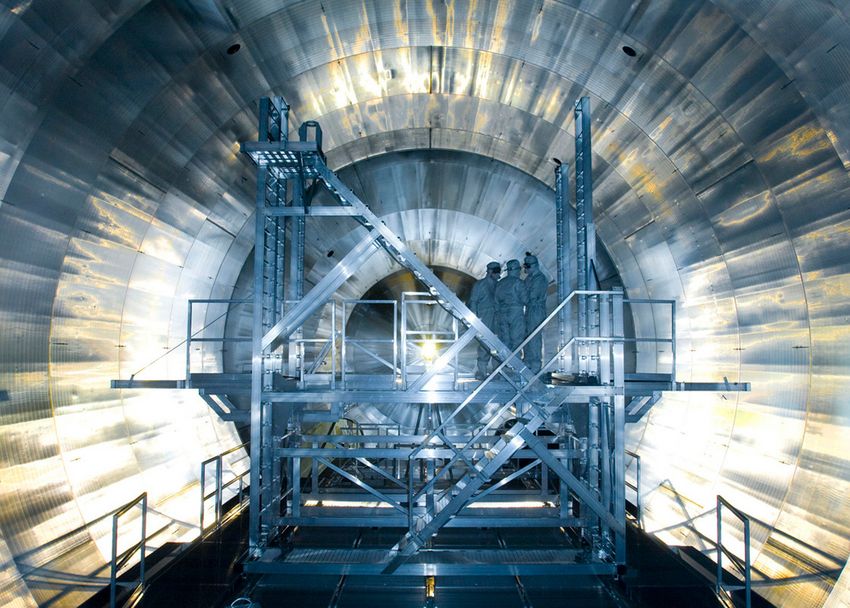
KATRIN Experiment Delivers Record-Breaking Precision
The latest breakthrough comes from the Karlsruhe Tritium Neutrino (KATRIN) experiment in Germany, a state-of-the-art facility designed specifically to hunt for neutrino mass signatures.
By analyzing the energy spectrum from tritium beta decay—a process where a tritium nucleus decays and releases an electron and an antineutrino—researchers can detect tiny distortions caused by the neutrino’s mass. This approach has now yielded unprecedented accuracy.
- Previous upper limit: Approximately 1.1 electronvolts (eV)
- New upper limit: Approximately 0.8 eV (with potential for even tighter constraints in future runs)
While the numerical difference seems small, in the world of particle physics, such refinements carry enormous weight. They refine models of the early universe and challenge assumptions in fundamental physics.
Why This Neutrino Mass Update Is a Big Deal
This halved mass ceiling isn’t just a minor tweak in a lab report—it’s a pivotal update with far-reaching implications across multiple scientific fields:
- Cosmology and galaxy formation: Neutrino mass influences how galaxies clump together and how the universe expands. Lighter neutrinos could require adjustments to current cosmological models.
- Beyond the Standard Model: A lower-than-expected mass might hint at undiscovered particles or forces, opening doors to new physics.
- Guiding future research: The results will shape the design of next-generation experiments, including Project 8 and PTOLEMY, which aim for direct, high-precision neutrino mass measurements.
In short, this finding narrows the playing field and sharpens the focus for ongoing quests to unlock neutrino secrets.
What Lies Ahead for Neutrino Science?
While the exact mass of neutrinos remains unknown, this tighter upper bound significantly limits theoretical possibilities. Upcoming studies will push sensitivity even further, potentially resolving key mysteries like the neutrino mass ordering (normal versus inverted hierarchy)—one of the biggest open questions in particle physics today.
As detector technology advances, scientists edge closer to determining whether neutrinos are truly massless or possess the tiniest of masses that could rewrite textbooks.
Conclusion
This landmark study revolutionizes our grasp of neutrinos, underscoring how these seemingly insignificant ghost particles hold clues to some of the universe’s grandest puzzles. From the tiniest subatomic scales to the vast expanse of cosmology, every refinement in neutrino mass understanding brings us one step closer to a more complete picture of reality. With cutting-edge experiments on the horizon, the future of neutrino research promises even more exciting revelations.
Frequently Asked Questions (FAQ)
What exactly is a neutrino? Neutrinos are fundamental, electrically neutral particles that interact extremely weakly with matter. Often dubbed “ghost particles,” they are produced in nuclear reactions, such as those in the sun or during radioactive decay, and stream through the cosmos at nearly the speed of light.
How did the KATRIN experiment measure neutrino mass? KATRIN studies the energy released during tritium beta decay. By precisely measuring the electron’s energy spectrum, scientists infer the neutrino’s mass from subtle effects it has on the decay process—the most sensitive method available to date.
What was the old versus the new neutrino mass limit? Earlier constraints placed the upper limit at around 1.1 eV. The new KATRIN results cut this to approximately 0.8 eV, effectively halving the maximum possible mass and providing the tightest bound yet.
Why does neutrino mass matter for the universe? Neutrino mass affects large-scale structures like galaxy clusters and the overall expansion rate of the universe. It also plays a role in testing the Standard Model of particle physics and searching for physics beyond it.
Will we ever know the exact mass of neutrinos? Ongoing and future experiments are working toward direct measurements. While we currently have only upper limits, advancing technology may soon reveal the precise values and resolve remaining questions about neutrino behavior.