





South Asia’s Next Generation at a Crossroads: The Growing Crisis of Child Nutrition
Something serious is happening to children across South Asia — and it isn’t the story most people expect to hear.
When we think about child health crises in this part of the world, the image that comes to mind is usually one of hunger. Malnourished children, food scarcity, poverty. That crisis is real and ongoing. But sitting alongside it now — and in some cases overtaking it — is something that looks entirely different on the surface: too many children are gaining weight they shouldn’t be, eating food that harms rather than nourishes, and developing chronic health problems that will follow them into adulthood.
UNICEF’s recent report, Feeding Profit: How Food Environments Are Failing Children, puts hard numbers to what nutritionists and public health workers in the region have been watching for years. The picture it paints is urgent.
Three Problems at Once
The term researchers use is “triple burden of malnutrition.” It sounds clinical, but what it describes is a situation where children in the same country — sometimes the same household — are simultaneously dealing with undernourishment, anemia, and obesity. These aren’t separate crises unfolding in different places. They’re overlapping, and they share common roots in food environments that simply aren’t working for children.
The numbers from the UNICEF report are stark. The count of overweight children between the ages of 5 and 19 across South Asia has multiplied fivefold since the year 2000. That’s not a gradual drift. It’s a rapid, measurable shift. Seventy million children in the region now fall into this category.
Perhaps the most significant threshold the report identifies is this: for the first time in recorded history, obesity among school-aged children and adolescents has overtaken being underweight as the more prevalent form of malnutrition. That’s a profound reversal — and one that many health systems in the region are not equipped to handle.
Perhaps the most significant threshold the report identifies is this: for the first time in recorded history, obesity among school-aged children and adolescents has overtaken being underweight as the more prevalent form of malnutrition. That’s a profound reversal — and one that many health systems in the region are not equipped to handle.

The School Problem
Schools were supposed to be safe environments — places where children learn, develop, and are protected. For many children in South Asia, they’ve become something else too: the place where daily eating habits are quietly shaped in the wrong direction.
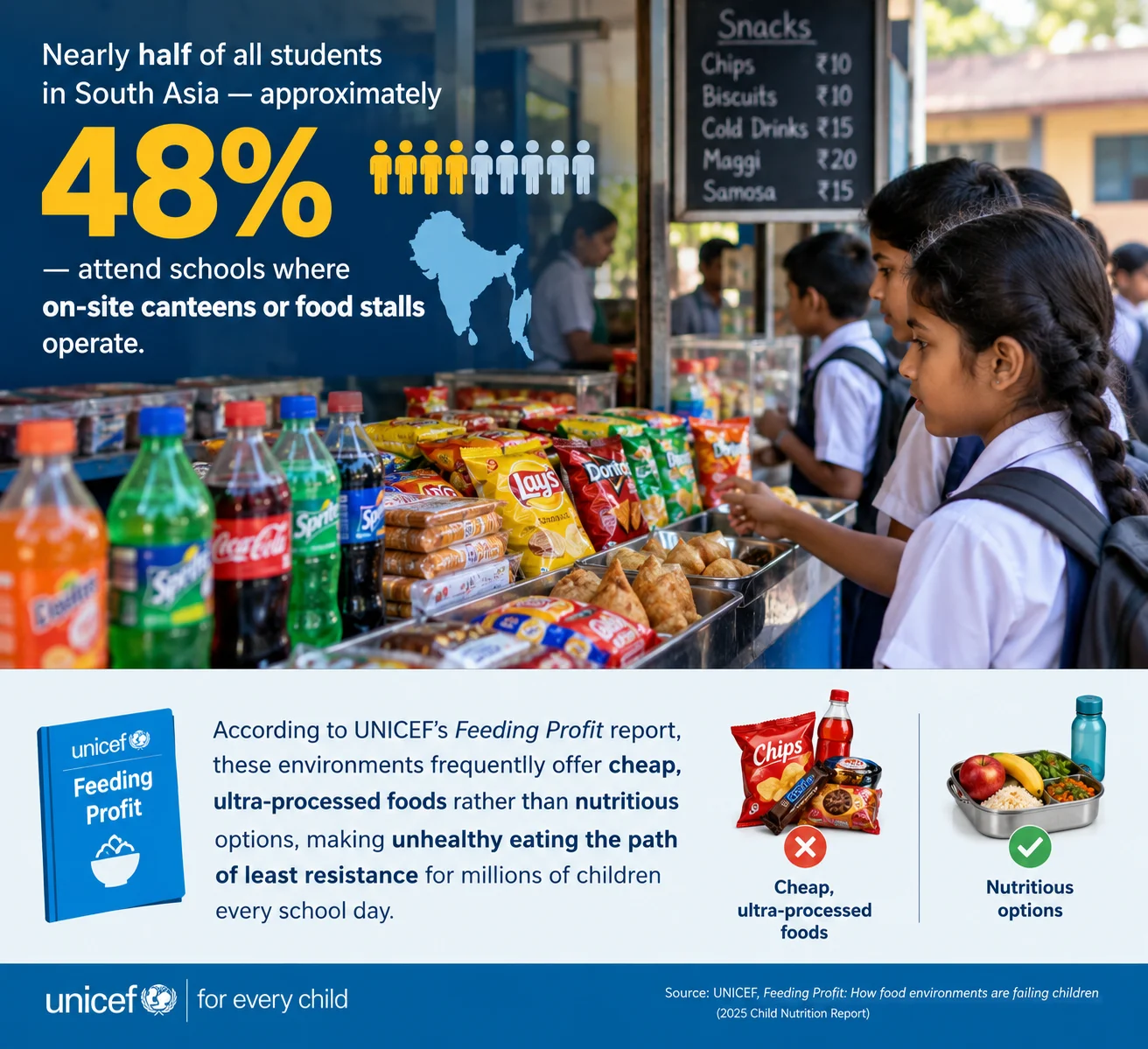
Close to half of all students across the region attend schools with canteens or food stalls on site. That fact alone isn’t the problem. The problem is what those stalls predominantly sell. Packaged snacks. Sugary drinks. Processed fast food that’s cheap, filling in the short term, and genuinely harmful over time.
Home-cooked meals, once the norm for most children in the region, are becoming less common. They’ve been replaced — not by better food, but by whatever is most available and most affordable in the school environment. Bangladesh is one of the countries where this shift is most visible, but it’s a pattern playing out across the region.
What makes this particularly concerning is that food habits formed during childhood are remarkably persistent. A child who spends years eating ultra-processed food as their primary school meal isn’t just at risk now. They’re being set up for metabolic problems, diabetes risk, and cardiovascular issues that may not fully manifest for another two or three decades.

What the UNICEF Report Found
The Feeding Profit report covers more ground than South Asia alone. Its findings are global in scope, and several stand out:
The obesity rise is happening everywhere. This isn’t a problem unique to South Asia or to wealthy nations. It’s a worldwide shift in how children eat and how food is produced and marketed to them.
The fastest growth is in countries least prepared for it. Low and middle-income countries are seeing the steepest increases in childhood obesity—and they typically have the weakest health infrastructure for managing the long-term consequences. Diabetes, cardiovascular disease, joint problems, and mental health impacts all follow in obesity’s wake, and these require sustained, well-resourced healthcare systems to address.
Obesity has become the dominant form of malnutrition. This is the headline finding that deserves the most attention. For the first time in history, among school-aged children and adolescents globally, obesity has become more common than being underweight. The framing of childhood malnutrition needs to expand — it is no longer solely a story about not having enough food.
Ultra-processed food is the common thread. Across all regions studied, children’s diets are increasingly built around foods that are high in sugar, salt, and unhealthy fats and low in nutritional value. These foods are also aggressively marketed — to children, through channels children use, using techniques specifically designed to build brand loyalty from a young age.
Conclusion
This is not a problem that solves itself. Food environments don’t improve by accident — they improve because people with the power to change them choose to do so.
The children growing up in South Asia right now are navigating food environments that were not designed with their health in mind. Many of them are eating the cheapest, most available thing — because that’s what their school sells, what their neighborhood stocks, what their family can afford. They’re not making bad choices. They’re making the only choices in front of them.
What needs to change is what those choices are. That means policy action on school food standards, meaningful regulation of how ultra-processed foods are marketed to children, investment in accessible fresh food, and nutrition education that’s practical rather than theoretical.
Seventy million overweight children in South Asia is a number that should prompt urgency. The health implications for those children — and for the healthcare systems that will eventually need to support them — are serious and long-term. But this is a problem that decisions made now can still meaningfully change. The question is whether those decisions will be made soon enough.
Disclaimer
This article is based on publicly available information from the UNICEF report “Feeding Profit: How Food Environments Are Failing Children” and related public health research. It is intended for general informational and educational purposes only and does not constitute medical, nutritional, or policy advice. Statistics cited reflect the findings of the referenced report and may be subject to revision as new data emerges. For the most current information, readers are encouraged to consult the original UNICEF report and official public health sources directly.
FAQ
Sources
| # | Source | Link |
|---|---|---|
| 1 | UNICEF — Feeding Profit: How Food Environments Are Failing Children (Main Report) | https://www.unicef.org/reports/feeding-profit |
| 2 | UNICEF — Child Nutrition Overview | https://www.unicef.org/nutrition |
| 3 | UNICEF — Feeding Profit Press Release | https://www.unicef.org/press-releases/feeding-profit |
| 4 | World Obesity Federation — Childhood Obesity Data | https://www.worldobesity.org/what-we-do/our-policy-work/childhood-obesity |
| 5 | Medtigo — UNICEF Feeding Profit Coverage | https://www.medtigo.com |
| 6 | ReliefWeb — Feeding Profit Report Summary | https://reliefweb.int/report/world/feeding-profit-how-food-environments-are-failing-children |
| 7 | NIH / PubMed — Ultra-Processed Food Consumption in Children | https://www.ncbi.nlm.nih.gov/pmc/articles/PMC8533532 |
| 8 | NIH / PubMed — Childhood Obesity in Low and Middle Income Countries | https://www.ncbi.nlm.nih.gov/pmc/articles/PMC5388469 |
| 9 | NIH / PubMed — South Asia Child Malnutrition Trends | https://pubmed.ncbi.nlm.nih.gov |
| 10 | WHO — Childhood Overweight and Obesity | https://www.who.int/news-room/fact-sheets/detail/obesity-and-overweight |
| 11 | NIH — Global Childhood Obesity Epidemiology | https://www.ncbi.nlm.nih.gov/pmc/articles/PMC6520036 |
| 12 | Earth.com — UNICEF Child Nutrition Report Coverage | https://www.earth.com |
| 13 | Florida Atlantic University — Child Obesity Research | https://www.fau.edu |

Health & Wellness Writer | Research-Informed Health Content Creator
A.K.M. Monjurul Hoque is a health and wellness writer specializing in health, beauty, fitness, nutrition and healthy living. His content is informed by health journals, books, seminars, training programs, and discussions with experienced healthcare professionals. He writes clear, practical and research-informed articles for general education and encourages readers to seek personalized advice from qualified medical professionals.