





How to Understand the Structure of a Human Cell
Every part of the human body begins with cells. A cell is the smallest unit of life that can carry out the basic processes needed to survive. Cells take in materials, make energy, remove waste, respond to signals, and reproduce.
Although cells are tiny, they are highly organized. Each one contains specialized parts called organelles, and each organelle has a particular job.
What Is a Human Cell?
A human cell is the basic building block of the body. Different cells are shaped and organized for different tasks. A red blood cell carries oxygen, a nerve cell sends messages, and a muscle cell helps the body move.
Humans have more than 200 specialized cell types. Together, they form tissues, organs, and body systems.
The Main Parts of a Human Cell
The following organelles are found in many human cells, although not every cell contains every structure in exactly the same way.
| Cell part | Main job |
|---|---|
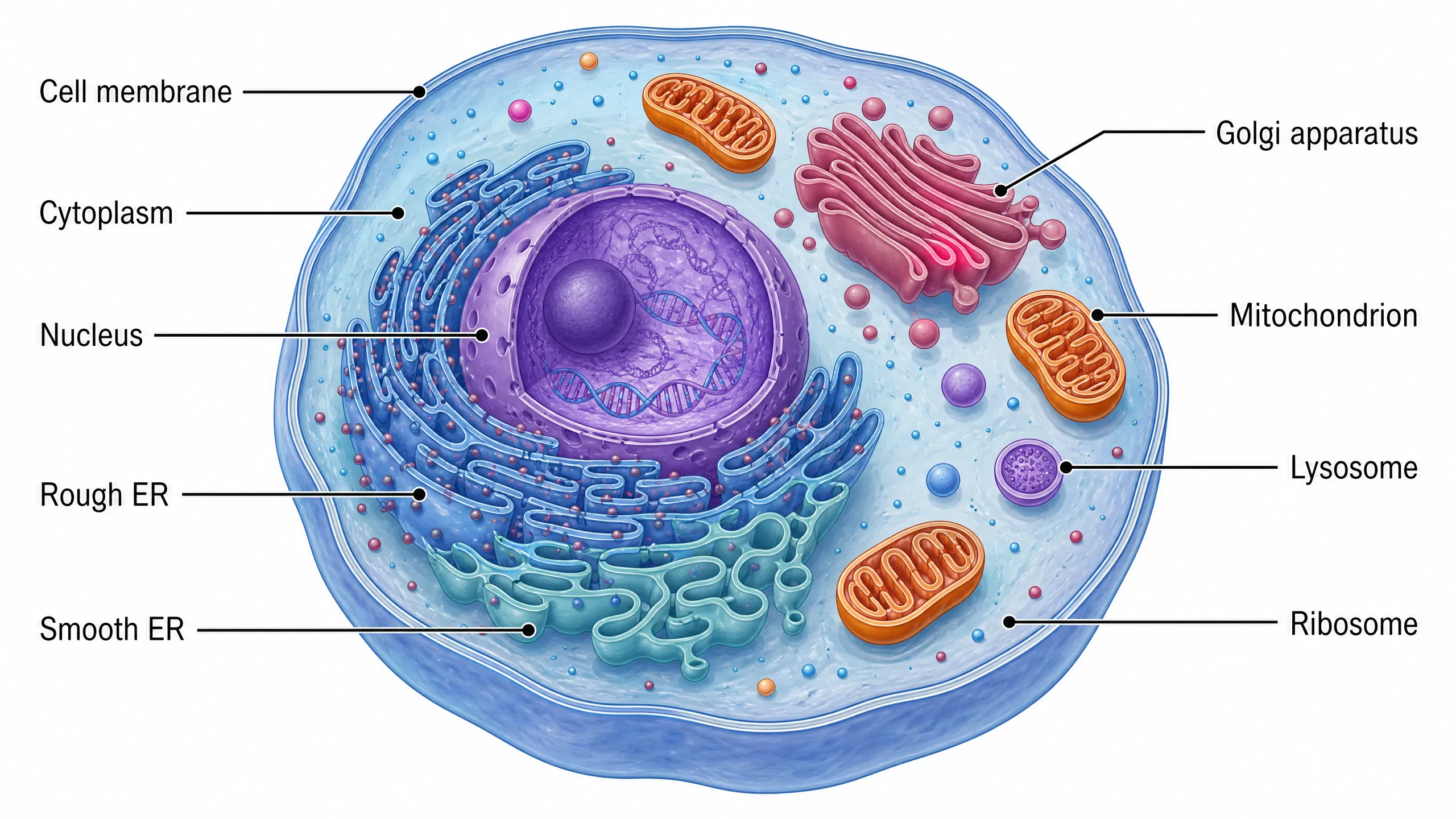
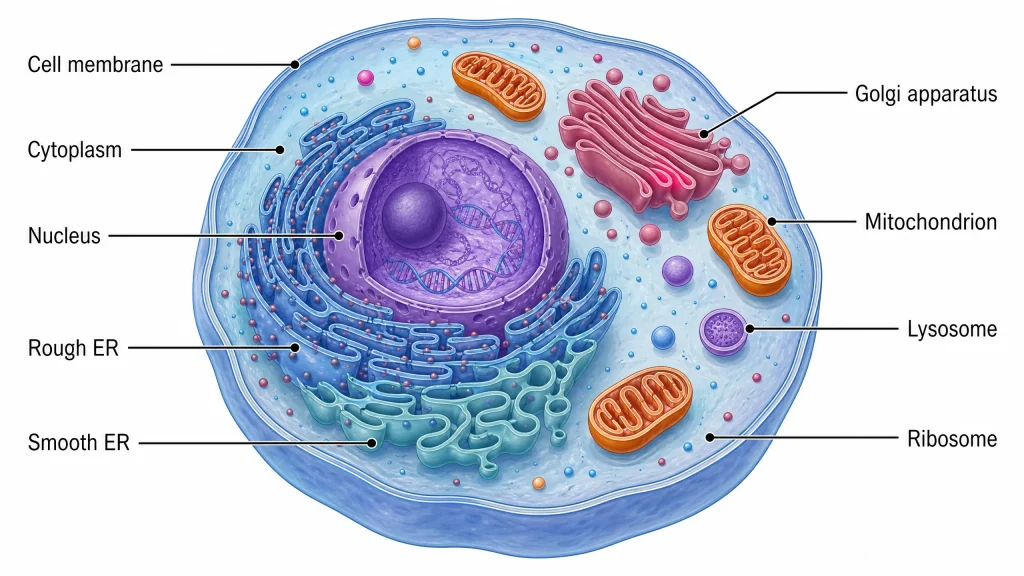
| Nucleus | Stores most of the cell’s DNA and helps control cell activity. |
| Cell membrane | Forms the cell’s outer boundary and controls what enters and leaves. |
| Cytoplasm | Jelly-like material inside the cell where many chemical reactions take place. |
| Endoplasmic reticulum | Helps make and process proteins and lipids. |
| Golgi apparatus | Modifies, sorts, and packages certain proteins and other materials. |
| Mitochondria | Produce much of the cell’s usable energy. |
| Lysosomes | Break down waste and worn-out cell parts. |
| Ribosomes | Build proteins from genetic instructions. |
The Nucleus: The Cell’s Information Center
The nucleus contains most of a cell’s DNA. DNA stores the instructions that help the cell make proteins and carry out its functions.
The nucleus does not control every action like a manager in a factory, but it does help regulate which genes are active and how the cell responds to its surroundings.
The Cell Membrane: The Cell’s Boundary
The cell membrane surrounds the cell. It separates the inside of the cell from the outside environment and controls the movement of substances in both directions.
This barrier is selective. It allows some materials to pass easily, while other substances need special transport proteins or energy to cross.
Cytoplasm: The Cell’s Working Space
Cytoplasm fills the inside of the cell around the nucleus and organelles. It contains fluid, proteins, salts, and other materials.
Many of the chemical reactions that keep a cell alive take place in the cytoplasm. It also helps support and position the organelles.
The Endoplasmic Reticulum: A Cellular Network
The endoplasmic reticulum, or ER, is a network of connected membranes. It has two main forms.
Rough ER has ribosomes attached to its surface. It helps make and process proteins that will be used in the cell or sent elsewhere.
Smooth ER does not have ribosomes. It helps make lipids, stores certain substances, and supports the processing of some chemicals.
The Golgi Apparatus: The Cell’s Packaging Center
The Golgi apparatus looks like a stack of flattened sacs. It receives proteins and other materials from the ER, makes final changes to them, and sorts them for delivery.
Some materials stay inside the cell. Others are sent to the cell membrane or released outside the cell.
Mitochondria: The Cell’s Energy Producers
Mitochondria help convert energy from food into a form the cell can use. Cells with high energy demands, such as muscle cells, often contain many mitochondria.
Mitochondria also have other roles, including helping regulate cell signaling and programmed cell death. Calling them the cell’s “powerhouses” is useful as a starting point, but their work is more complex than energy production alone.
Lysosomes: The Cell’s Recycling System
Lysosomes contain enzymes that break down waste, damaged cell parts, and materials brought into the cell. The cell can sometimes reuse the smaller components created during this process.
This recycling system helps the cell stay organized and prevents unwanted material from building up.
Ribosomes: Protein Builders
Ribosomes read genetic instructions and join amino acids together to make proteins. Some ribosomes float freely in the cytoplasm, while others attach to the rough ER.
Proteins perform many important jobs. They help build cell structures, speed up chemical reactions, carry messages, and move materials around the body.
How the Organelles Work Together
Cell organelles do not work in isolation. They form a coordinated system.
The nucleus provides genetic instructions. Ribosomes use those instructions to build proteins. The rough ER helps process certain proteins, and the Golgi apparatus sorts and packages them. Mitochondria provide much of the energy needed for these activities, while lysosomes break down waste and help recycle materials.
This cooperation allows a cell to grow, respond to its environment, repair itself, and perform its specialized role.
Why Cell Biology Matters
Learning about cells helps us understand how the body works. It also provides a foundation for studying genetics, disease, medicines, aging, and many other areas of biology.
When a cell’s normal processes are disrupted, the effects can spread to tissues and organs. For example, problems with DNA repair, energy production, or cell communication can contribute to disease. Cell biology helps researchers understand these changes and develop better treatments.
Interesting Facts About Human Cells
Estimates of the number of human cells in an adult body vary depending on the person and the method used. A widely cited modern estimate is around 30 trillion human cells, while older estimates commonly used figures near 37 trillion. The exact number is not a fixed value.
Red blood cells are among the most numerous cells in the body. They are specialized to carry oxygen and have no nucleus when mature.
Cell lifespans also vary widely. Some cells are replaced within days, while others can last for years or, in some cases, for most of a person’s life.
Cells communicate through chemical signals and direct contact. This communication helps coordinate growth, movement, immune responses, and the work of organs.

References
1.National Human Genome Research Institute — Organelle
2.National Institute of General Medical Sciences — Take a Tour of Your Cells’ Organelles
3.National Cancer Institute — Cell Structure
4.National Center for Biotechnology Information — Histology, Cell
5.Sender et al. — Revised Estimates for the Number of Human and Bacteria Cells in the Body
Disclaimer
This article is for general educational purposes. It provides a simplified overview of cell biology and does not replace a biology textbook, classroom instruction, or professional medical advice.
Frequently Asked Questions
Conclusion
Human cells are tiny, but they are not simple. Each organelle has a role, and the parts work together to keep the cell alive and responsive.
Once you understand the basic jobs of the nucleus, membrane, cytoplasm, ER, Golgi apparatus, mitochondria, lysosomes, and ribosomes, the structure of a cell becomes much easier to follow. More importantly, it becomes clear how the health of individual cells supports the health of the entire body.

Health & Wellness Writer | Research-Informed Health Content Creator
A.K.M. Monjurul Hoque is a health and wellness writer specializing in health, beauty, fitness, nutrition and healthy living. His content is informed by health journals, books, seminars, training programs, and discussions with experienced healthcare professionals. He writes clear, practical and research-informed articles for general education and encourages readers to seek personalized advice from qualified medical professionals.