




The Anti-Aging Elixir? It Might Be Hiding in Plain Sight
We spend billions chasing youthful skin. We buy beauty creams, experiment with exotic “superfoods” and look for the next big wellness breakthrough.
But when it comes to aging well, the most useful strategy may be far less glamorous—and already sitting in your living room.
It’s called strength training.

One exercise in particular, the humble lunge, can be a practical starting point. Fitness coach Rachael Sacerdoti, founder of It’s So Simple, has emphasized the importance of building and maintaining muscle as part of a healthier, more active lifestyle. Her approach focuses on realistic workouts that can fit into busy routines.
And while no single exercise can literally stop aging, the science behind strength training is compelling. Studies show that resistance training can improve muscle strength in older adults, while broader evidence suggests it can also support physical function and mobility.
Why Muscle Matters as We Age
Getting older naturally changes muscle mass and strength. That does not mean decline is inevitable or that you cannot build strength later in life.
In fact, research involving older and even very elderly adults has found that resistance training can produce meaningful improvements in muscle strength and, in some cases, muscle size.
That matters in everyday life.
Stronger legs can make ordinary movements—standing up, climbing stairs, walking and maintaining independence—easier. Research also links resistance training with improvements in walking ability and physical performance among older adults.
So perhaps the better way to think about strength training is not as a “fountain of youth,” but as a tool for aging with greater strength and physical independence.
Why Start With the Lunge?
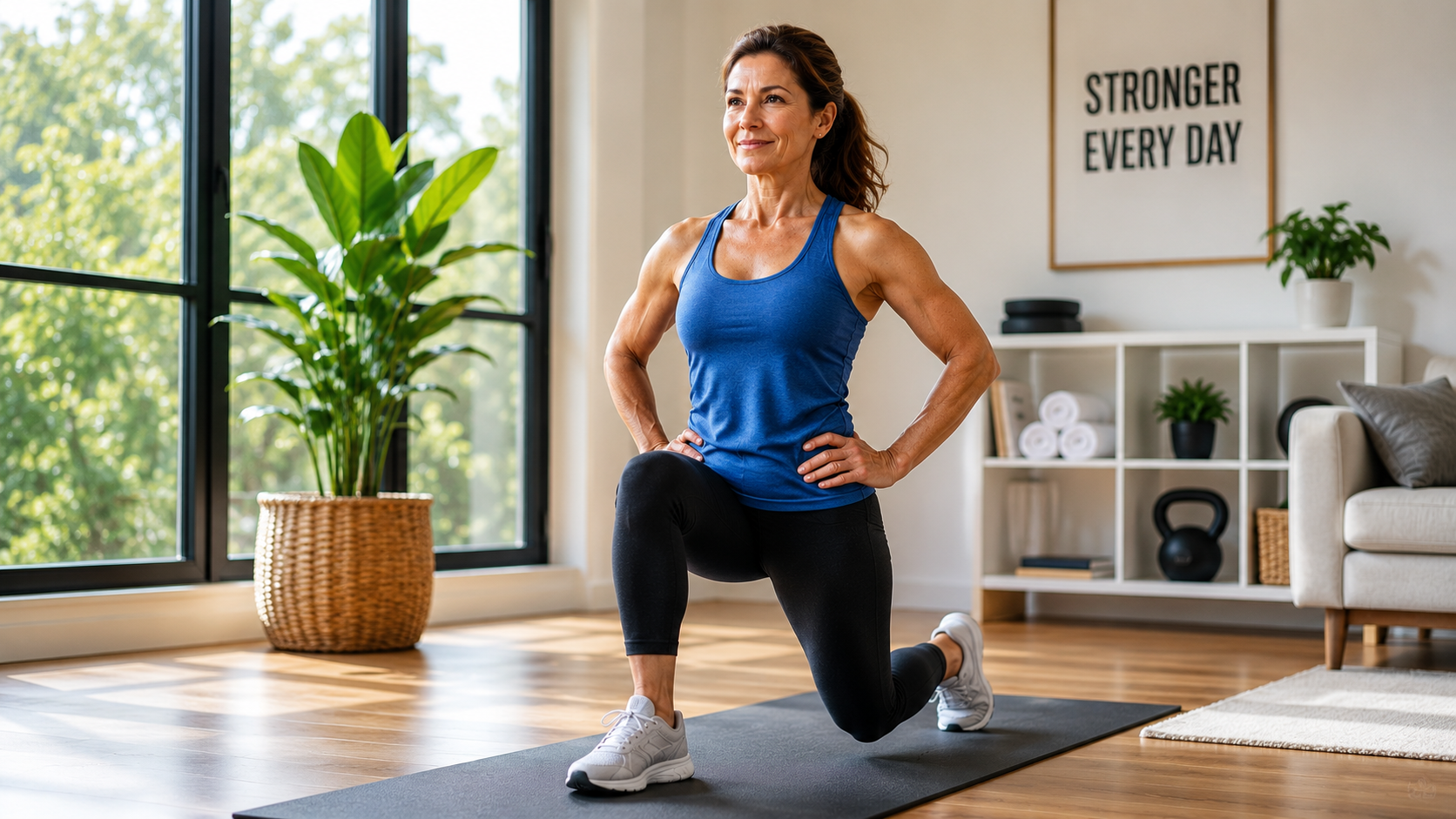
The lunge is a simple lower-body exercise that can be performed with bodyweight and progressed gradually as strength improves.
A basic lunge challenges several lower-body muscles while also requiring you to control your body position. Variations can add a balance and coordination component, too.
The important point is that the lunge should be viewed as one useful exercise within a complete strength-training routine, rather than a magic exercise that can deliver every health benefit on its own.
WHO recommends that adults perform muscle-strengthening activities involving the major muscle groups on two or more days per week, alongside regular aerobic activity.
How to Perform a Basic Forward Lunge
1. Start tall
Stand with your feet approximately hip-width apart. Keep your chest lifted and your core gently engaged.
2. Step forward
Take a controlled step forward with one foot.
3. Lower under control
Bend both knees as you lower your body. Aim to keep your movement controlled rather than dropping quickly.
4. Push back
Drive through the front foot to return to the starting position.
5. Repeat
Begin with a manageable number of repetitions and gradually increase the challenge as your technique improves.
For beginners, bodyweight lunges are often enough to learn the movement. Dumbbells can be introduced later when additional resistance is appropriate.
Try the reverse lunge
Reverse lunges follow the same basic pattern, but instead of stepping forward, you step backward.
Stand upright, step one foot behind you, bend both knees, lower with control, then push through the front leg to return to standing.
Some people find reverse lunges easier to control than forward lunges. The best variation is the one you can perform safely and consistently with good technique.
Common Lunge Mistakes
The Tightrope Problem
Avoid placing your feet directly one behind the other as though you are walking on a tightrope. A slightly wider stance can provide better balance.
Losing Knee Control
Your front knee should track in line with your foot rather than collapsing inward.
Rushing the Movement
Slow, controlled repetitions are generally more useful for learning proper technique than racing through each rep.
Going Too Deep Too Soon
Your range of motion should match your mobility and training experience. You do not have to force a deep lunge to make the exercise worthwhile.
How to Make Lunges More Challenging
Once bodyweight lunges become comfortable, progression can come from additional resistance, more controlled repetitions, or a gradual increase in training volume.
This concept is known as progressive overload—gradually increasing the training challenge as your body adapts.
But more is not automatically better.
Pushing every set to absolute failure is not necessary for everyone, and beginners should prioritize technique, recovery and consistency. Research in older adults suggests that different resistance-training volumes can improve physical function and muscle-related outcomes, with the appropriate amount depending on the goal and individual circumstances.
How Often Should You Train?
For general health, WHO recommends muscle-strengthening activities involving the major muscle groups on at least two days per week.
That does not mean you need to perform lunges every day.
A balanced routine could include lunges alongside other lower-body exercises, upper-body strengthening, core work and regular aerobic activity.
The real secret is consistency.
A few minutes of exercise that you actually perform week after week is far more useful than an ambitious workout plan that you abandon after a few sessions.
The Bigger Picture: Strength for Healthy Aging
Calling lunges an “anti-aging elixir” makes for a great headline, but the evidence supports a more grounded message.
There is no single exercise that stops aging.
What the research does show is that strength training can help older adults improve muscle strength and physical performance—and those abilities are important components of maintaining mobility and independence.
So the next time you think you need an expensive treatment, complicated routine or exotic wellness trend to support healthy aging, remember the basics.
Move regularly. Build strength. Challenge your muscles progressively. Recover properly. And make exercise a habit you can sustain.
Sometimes, the most valuable health tools really are hiding in plain sight.
Conclusion
The lunge is not a miracle cure for aging—and it cannot replace a well-rounded exercise programme, healthy nutrition or medical care.
But it can be a simple entry point into strength training.
Whether you’re in your 30s, 50s, 70s or beyond, maintaining strength is worth investing in. Research shows that older adults can still respond positively to resistance training, making strength work an important part of healthy aging.
Start where you are, focus on good form, and build gradually.
Your future self may thank you.
FAQ
Disclaimer
This article is for general educational and informational purposes only. It is not medical advice and should not be used to diagnose, treat or prevent a medical condition. Exercise can carry risks, particularly for people with injuries, joint problems, cardiovascular conditions, significant balance limitations or other health concerns. Consult a qualified healthcare professional or exercise professional before beginning a new exercise programme when appropriate. Stop exercising if you experience significant pain, dizziness, chest pain or unusual shortness of breath.
Sources / Reference Links
- World Health Organization (WHO) — Physical Activity
https://www.who.int/initiatives/behealthy/physical-activity - WHO — Guidelines on Physical Activity and Sedentary Behaviour
https://iris.who.int/handle/10665/336656 - PubMed — Resistance Training in Very Elderly Adults: Systematic Review & Meta-Analysis
https://pubmed.ncbi.nlm.nih.gov/32740889/ - PubMed — Effects of Resistance Training Volume in Older Adults: 151 Randomized Trials
https://pubmed.ncbi.nlm.nih.gov/39405023/ - PubMed — Resistance Training and Physical Function in Older Adults
https://pubmed.ncbi.nlm.nih.gov/37774931/ - PubMed — Resistance Training, Quality of Life & Physical Function in Older Adults
https://pubmed.ncbi.nlm.nih.gov/35968662/ - It’s So Simple — Rachael Sacerdoti / Fitness Programme
https://www.itssosimple.co.uk/

Health & Wellness Writer | Research-Informed Health Content Creator
A.K.M. Monjurul Hoque is a health and wellness writer specializing in health, beauty, fitness, nutrition and healthy living. His content is informed by health journals, books, seminars, training programs, and discussions with experienced healthcare professionals. He writes clear, practical and research-informed articles for general education and encourages readers to seek personalized advice from qualified medical professionals.