




The Ice Bucket Challenge 2026: How One Cold Splash Can Support the Fight Against ALS
Introduction: From Viral Moment to Lasting Movement
A bucket of ice water, a smartphone, and a willingness to help turned into one of the most recognizable fundraising campaigns of the digital age. The ALS Ice Bucket Challenge first captured global attention in 2014, inviting people to pour ice water over their heads, donate to ALS organizations, and nominate others to continue the chain.
More than a decade later, the campaign’s legacy reaches well beyond social media. The original challenge raised approximately $115 million for The ALS Association and helped fund research, patient services, and advocacy initiatives. The campaign also supported work that contributed to the discovery of ALS-related genes, including NEK1, a finding that gave researchers a valuable new target for investigation. [1] [2] [3]
The 2026 campaign offers an opportunity to revisit that energy—but with a more thoughtful focus: participation should support verified ALS organizations, amplify the voices of people living with the disease, and encourage safe, meaningful action rather than chasing views alone.
What Is the Ice Bucket Challenge?
The Ice Bucket Challenge is a social-media fundraising activity created to raise awareness and money for amyotrophic lateral sclerosis, commonly known as ALS or Lou Gehrig’s disease. ALS is a progressive neurodegenerative disease that affects nerve cells responsible for voluntary muscle movement. As the condition advances, people may experience increasing difficulty with movement, speech, swallowing, and breathing. [4]
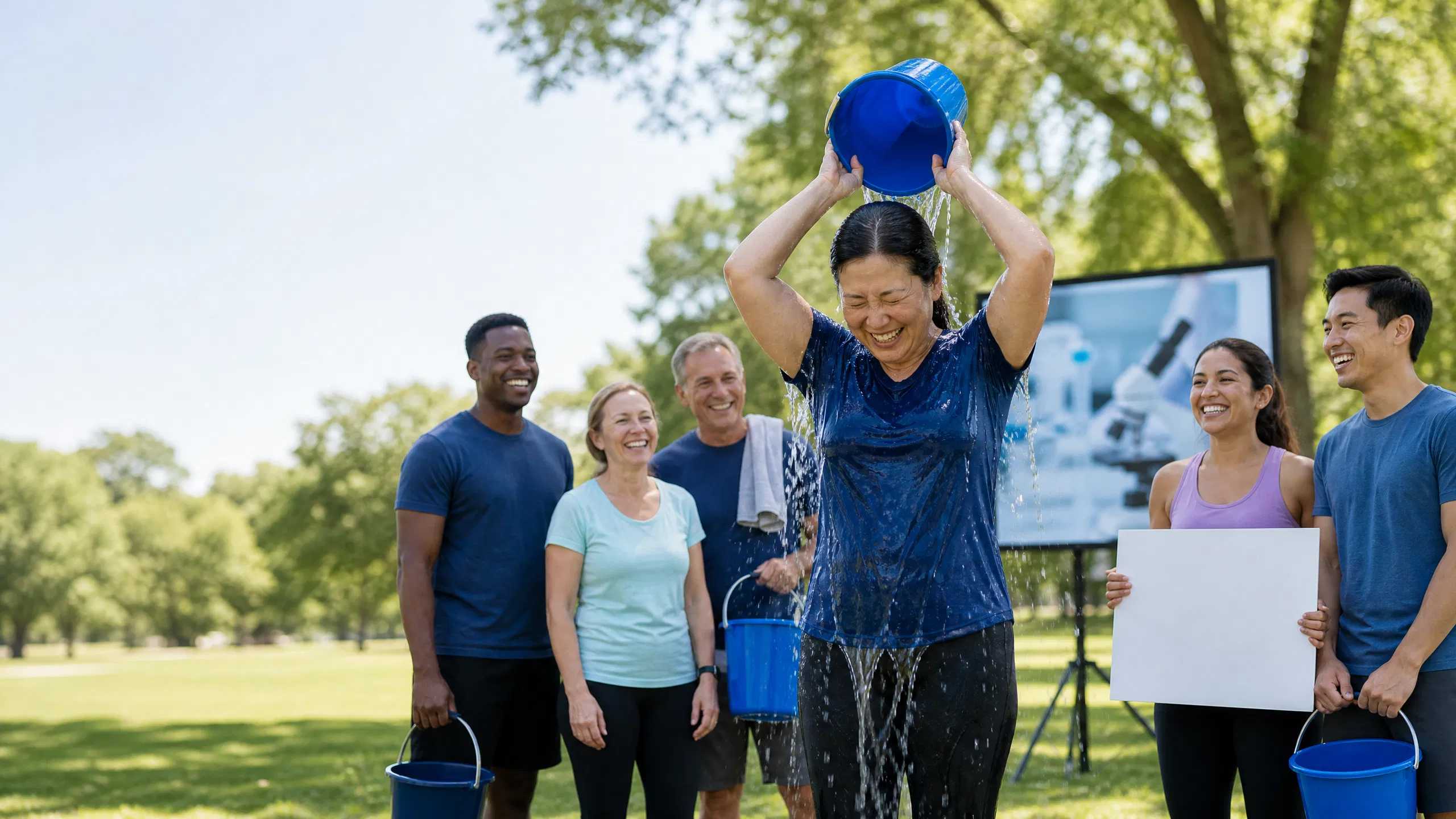
The challenge became powerful because it was simple to understand and easy to share. Participants usually recorded themselves receiving a bucket of cold water, explained the cause, donated or encouraged donations, and nominated friends or family members to take part.
However, the water is only the visible part of the campaign. The real objective is to direct attention and financial support toward people living with ALS, their caregivers, and researchers searching for better treatments.
The 2014 Campaign and Its Scientific Legacy
The 2014 Ice Bucket Challenge demonstrated how online participation could translate into substantial real-world funding. The ALS Association reports that the campaign helped unite approximately 17 million participants and generated about $115 million for its work. [1]
That funding supported research projects around the world. According to The ALS Association, donations helped fund the discovery of several ALS-associated genes, including NEK1. The broader research effort also supported collaborations, clinical investigations, and the development of tools that continue to shape the study of ALS. [1] [3]
| Area of impact | How campaign funding helped |
| Research | Supported studies into ALS biology, genetics, causes, and potential treatments. |
| Patient services | Helped organizations provide information, equipment, care resources, and support for individuals and families. |
| Public awareness | Introduced millions of people to ALS and the experiences of those living with it. |
| Scientific collaboration | Enabled researchers and institutions to work across borders and disciplines. |
It would be inaccurate to suggest that one viral campaign discovered a cure. Scientific progress is cumulative and often takes years. The Ice Bucket Challenge’s most credible legacy is that it accelerated funding and visibility for a disease that had previously received far less public attention.
What the 2026 Challenge Means Today
The 2026 version should not be treated simply as a repeat of a 2014 trend. Its value depends on how responsibly people participate and where their donations go. The strongest campaigns connect the visual appeal of a short video with useful information about ALS, legitimate fundraising links, and respect for the people directly affected by the disease.
The ALS Association’s current campaign materials describe the Ice Bucket Challenge as an ongoing movement and invite supporters to help close the gap between awareness and sustained action. [1]
Because online campaigns can be copied or misrepresented, participants should verify the organization behind a fundraising link before donating. If a post makes an extraordinary claim, pressures people to give immediately, or directs users to an unfamiliar payment account, pause and investigate first.
How to Participate Safely in the 2026 Ice Bucket Challenge
You do not need expensive equipment or a large following to contribute. A safe, sincere video can be enough to start a conversation.
1. Choose a verified cause
Use the official website of a recognized ALS organization, such as The ALS Association, ALS Therapy Development Institute, or an established national ALS charity in your country. Check the organization’s name, web address, donation process, and current campaign information before sharing a link.
2. Prepare a safe setup
Choose an outdoor location with stable footing and enough space. Use a manageable container rather than an excessively heavy bucket. Keep electrical equipment, stairs, slippery surfaces, and nearby traffic out of the setup.
3. Use cool water responsibly
The goal is awareness—not physical danger. You can use cold water with little or no ice, pour it over your shoulders instead of your head, or choose a completely different action if the traditional version is unsuitable. People with heart or circulation conditions, cold sensitivity, breathing problems, balance concerns, or other health risks should avoid the cold-water stunt and consider donating or sharing educational information instead.
4. Explain the purpose
A strong video identifies ALS, acknowledges the people and families affected by it, and includes a clear link to a verified organization. Avoid presenting the challenge as a substitute for medical care or implying that donations guarantee a cure.
5. Invite participation without pressuring anyone
Nominate friends who may enjoy taking part, but make it clear that donating, learning, volunteering, or sharing reliable information are equally valid ways to help.
Safety First: Alternatives to the Traditional Water Pour
Not everyone should—or wants to—have ice water poured over their head. The campaign can remain inclusive by offering alternatives such as:
| Alternative | How it supports the cause |
|---|---|
| Donate directly | Sends funds to research, patient support, or advocacy. |
| Share an educational post | Helps more people understand ALS and its effects. |
| Wear the campaign color or symbol | Creates visibility without a cold-water stunt. |
| Host a small fundraiser | Invites friends, coworkers, or community members to contribute. |
| Volunteer or contact an ALS organization | Supports local services and awareness efforts. |
If someone feels unwell during or after a cold-water activity, they should stop, warm up gradually, and seek medical assistance when symptoms are serious or persistent. The campaign should never encourage reckless behavior for entertainment.
Where Donations Can Make a Difference
Funds raised through ALS campaigns may support several areas, including laboratory research, clinical-trial development, assistive equipment, caregiver resources, disease education, and public policy. Exact allocations vary by organization, so donors should read the charity’s financial reports and program information before contributing.
Research funding is especially important because ALS is biologically complex and can affect people differently. Scientists are studying genetic factors, cellular processes, motor-neuron protection, biomarkers, and potential therapies. Progress in any one area may not immediately translate into a treatment, but it can provide the evidence needed for the next stage of research.
The Role of Celebrities and Social Media
Public figures helped the 2014 challenge spread rapidly, but the campaign’s reach did not depend only on celebrities. Ordinary families, school groups, sports teams, workplaces, and people living with ALS all helped turn a short video format into a global conversation.
In 2026, social media creators can make their participation more useful by adding context rather than posting only a reaction. A few accurate sentences about ALS, a verified donation link, and a respectful acknowledgment of affected families can transform a novelty clip into genuine advocacy.
Visibility matters, but it should not overshadow the people at the center of the cause. The most responsible content avoids pity-based messaging and presents individuals living with ALS as people with agency, dignity, families, careers, interests, and stories—not merely as fundraising symbols.
Conclusion: Make the Moment Mean More
The Ice Bucket Challenge remains a striking example of how collective online action can support serious scientific and humanitarian work. Its 2014 success helped raise approximately $115 million, expand ALS awareness, and accelerate research funding. [1] [2]
If you participate in 2026, let the cold water be the beginning of the message—not the whole message. Choose a verified charity, follow basic safety precautions, share accurate information, and remember that a direct donation or thoughtful act of advocacy can be just as meaningful as a viral video.
A brief moment of discomfort may attract attention. Sustained compassion, responsible giving, and continued research are what create lasting impact.
Frequently Asked Questions
What is the purpose of the 2026 Ice Bucket Challenge?
The purpose is to raise awareness and funds for ALS research, patient support, and advocacy. The campaign builds on the global movement that became widely known in 2014.
Do I have to pour ice water over my head to participate?
No. You can donate directly, share reliable information, organize a fundraiser, volunteer, or choose a safer alternative such as using cool water without ice. Participation should be voluntary and appropriate for your health.
How much money did the original Ice Bucket Challenge raise?
The ALS Association reports that its 2014 campaign raised approximately $115 million. Other organizations and countries also received funds, so global totals may differ depending on the accounting method used. [1] [3]
Did the Ice Bucket Challenge help scientists discover an ALS gene?
Yes. Funding connected to the campaign contributed to research that helped identify ALS-associated genes, including NEK1. However, the campaign did not produce a cure by itself; scientific discoveries result from ongoing work by many researchers and institutions. [1] [2]
Where should I donate?
Donate through the official website of a recognized ALS organization or a reputable charity in your country. Avoid unfamiliar links, pressure tactics, and requests for payment through unverified personal accounts.
Is the Ice Bucket Challenge safe for everyone?
No. Cold-water exposure may be inappropriate for people with certain medical conditions, cold sensitivity, circulation or breathing concerns, or balance problems. Anyone who is uncertain should skip the stunt and support the cause another way.
How can I make a challenge video more effective?
Keep it concise, explain what ALS is, name a verified organization, provide a legitimate donation link, and nominate others without pressuring them. Accessibility matters too, so consider captions and a clear spoken explanation.
Disclaimer
This article is provided for general education and awareness. It is not medical advice, a substitute for professional care, or a guarantee about how donations will be used. Cold-water activities can pose risks, particularly for people with underlying health conditions. Consult a qualified healthcare professional if you are unsure whether participation is appropriate. Always verify charities, campaign claims, and donation links through official sources before contributing.
The article has been newly written from the supplied material and publicly available references. No writer or tool can guarantee a literal “100% plagiarism-free” result without checking every publication and database; readers should use a plagiarism-detection service if formal originality verification is required.
References
1.The ALS Association — Ice Bucket Challenge
2.The ALS Association — Ice Bucket Challenge Dramatically Accelerated the Fight Against ALS
3.BBC News — Ice Bucket Challenge Funds Gene Discovery in ALS
4.National Institute of Neurological Disorders and Stroke — Amyotrophic Lateral Sclerosis
5.NPR — The Ice Bucket Challenge Helped Fund a New ALS Drug
6.Nature — Fundraising: The Ice Bucket Challenge Delivers
7.ALS Therapy Development Institute — Ice Bucket Challenge


Health & Wellness Writer | Research-Informed Health Content Creator
A.K.M. Monjurul Hoque is a health and wellness writer specializing in health, beauty, fitness, nutrition and healthy living. His content is informed by health journals, books, seminars, training programs, and discussions with experienced healthcare professionals. He writes clear, practical and research-informed articles for general education and encourages readers to seek personalized advice from qualified medical professionals.