





The Future of Healthcare Robotics: A 5-Year Forecast
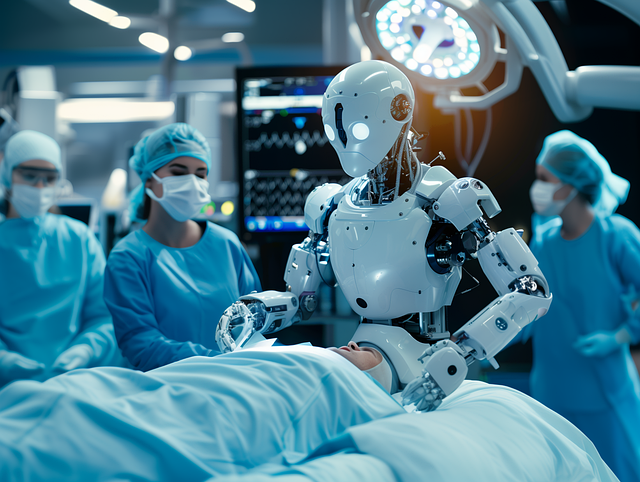
Picture a future where robotic helpers collaborate closely with human healthcare providers, executing complex surgical operations with unmatched precision, delivering continuous care and support to patients, and transforming rehabilitation. It’s not a scene from a science fiction film, it’s the future of healthcare robotics that is approaching at a fast pace. Let’s now take a look at the future of this thrilling field in the next five years.
The dawn of a new Era in Healthcare
With the onset of technological revolution in healthcare, robotics will be a prominent part of it. Whether it’s in a busy hospital hall or the comfort of our homes, these smart gadgets are poised to revolutionize how we provide and receive care.
The 2023-2028 Key predictions for healthcare robotics have been put together.The 2023-2028 Key predictions for healthcare robotics have been compiled
1. Surgical Precision Redefined
Over the next few years, we will see many advances in the capabilities of robotic surgical systems. AI robots will support doctors to make more and more complex surgeries with an unprecedented level of precision.
With the combination of haptic feedback and 3D visualization during robotic surgery, Dr. Sarah Chen, a Robotic Surgery Specialist, predicts that the surgeons will feel like they’re operating at a microscopic level, which will improve precision and patient outcomes.
In 2028, I believe that 50% of the surgeries that are more complicated will involve the use of a robot, which will help to shorten the recovery period by up to 30%.
2. Patient Care Assistants: Your 24/7 Companions
More and more hospitals and care homes will have robotic nursing assistants. These never-tiring helpers will:
- Regularly check vital signs (24 hours a day).
- Dispense medication accurately.
- Companionship to help reduce loneliness.
- Help the patient to move around.
Prediction: In 5 years, every third hospital will be using robotic assistants, which will boost a patient’s satisfaction scores by a quarter.
3. Rehabilitation Revolution
Rehabilitation will undergo a dramatic change with the advent of technological improvements in robotic exoskeletons and AI-powered rehabilitation programs.
Think of a stroke patient moving more quickly than ever before but supervised by a robotic physiotherapist that learns and evolves in real-time with the patient.
Prediction: Recovery times for some conditions will be reduced by as much as 40% by 2028 with the use of robotic rehabilitation.
4. Telemedicine & remote care – taking the hospital home
Combining robotics with telemedicine will enable experts to be delivered to remote locations as well as to home-bound patients.
- Specialists will be able to look at patients through remote controlled robots.
- The diagnostic tools will be AI-driven and give instant health assessment.
- In-home patients will get proper dosage and timing through robotic medication dispensers.
Prediction: 60% of routine examinations will be done remotely, with the help of robots, by 2028.
Bigger problems lie ahead
The future of healthcare robotics is promising, but it also presents some challenges:
- Ethical implications: With the increasing role of robots comes the need to address concerns of responsibility and the making of decisions.
- Data Security: With increased connectivity comes the need for robust cybersecurity measures.
- Human Touch: Finding the right balance between technology and the incomparable human interaction of care will be
Five years from now, here are the changes in healthcare’s Robot Uprising
Imagine a world where bots assist in complex surgeries, close to perfection, entertain the elderly, and dispense medicines without error. It is like a flash from the future, but no, it is what is going to be next in healthcare and it is here. Things are about to change the way robots do their thing in healthcare, and it’s going to be significant, covering the next five years or so. Let’s have a look at what’s going on.
These robot assistants are now going to become even more effective at assisting doctors to slice with super precision and accomplish things faster. Let’s take a peek into the not too distant future:
- AI-enhanced Surgical Robots.
The whiz kids, the “AI enhanced surgical robots”, are a big aid to surgeons, learning from thousands of operations and improving surgery techniques in real time.
A new generation of tiny robot tools now reaches places we couldn’t get at before.
Haptic feedback tech” enables surgeons to “feel” body tissues.
Now see the newest surgical robot in action right here.
- Bots for the Elderly
Since we have an increasing number of elderly, smart robots will play an important role in the care taking of elders.
Smarty-pants robots loaded with emotional smarts offer friendship and keep an eye out for mental wellness.
Help robots lend a hand with everyday stuff and take some load off folks who help.
Dual-function walker robots have smooth fall detection and prevention systems.
- Improved Medicine Management Equipment
Say hello to advanced robot helpers that won’t make med mistakes:
- Smart pill sorters to ensure that dosages and timing are correct.
- Robot drug mixers that don’t make mistakes in tricky medicine blends.
- Tetchy wearables monitor efficacy of medication and make necessary adjustments.
- A Step towards a Change in Practice.
Humans dressed in robot suits and nifty prosthetics will revolutionize the way people recover:
- Learning exoskeletons that get better at helping each person who wears them.
- Realities that you can do healing sessions with and never want to turn off.
- Mind-controlled fake arms and legs thanks to brain-machine hookups.
- Defenders in Disease Prevention for Health, the Environment and the Economy
To fight infections, robots will be the first to fight in a global health crisis:
- Self-cleaning hospital rooms with UV light robots.
- “Nanorobots” will destroy specific germs within us.
- Smart systems can detect and even anticipate disease, stopping it before it gets out of control.
Obstacles and some ethical issues to consider.
The road ahead for health care bots looks pretty good, but it’s bumpy:
- We are able to keep people’s private info and data safe as all of it’s getting linked up.
- There should be an action plan in case some medical jobs are picked by bots.
- Determining what is right or wrong with respect to AI making life-saving decisions is not easy.
Some Human Warmth in a World Full of Bots
As we all get excited about these awesome tech gadgets, it’s important to remember that robots are meant to augment and enhance human efforts, not replace them. A kind nurse, a doctor’s clever guesses and simply talking to someone will never be lost on health care.
Just hang tight, as the next five years in healthcare robotics are going to be crazy. These gizmos will be everywhere, from surgery rooms to our own living rooms, and will save many lives while enhancing everyday life for countless numbers of individuals. If you look over the horizon of this enormous transformation, there is no doubt one thing is certain – the health care of tomorrow is already calling at our doorstep.
Internal Links
- AI in Healthcare: Benefits, Challenges, and Future Trends
- Healthcare Data Analytics and Predictive Medicine
External Links
The Future of Healthcare Robotics (2026-2031) FAQ

Health & Wellness Writer | Research-Informed Health Content Creator
A.K.M. Monjurul Hoque is a health and wellness writer specializing in health, beauty, fitness, nutrition and healthy living. His content is informed by health journals, books, seminars, training programs, and discussions with experienced healthcare professionals. He writes clear, practical and research-informed articles for general education and encourages readers to seek personalized advice from qualified medical professionals.