


Before You Walk Again: 6 Simple Exercises That Make Recovery Safer
The pressure to hit 10,000 steps a day is real—and when you’re coming back from an injury, an illness, or just a long stretch of not moving much, that number can feel less like a goal and more like a threat.
Most people who struggle with returning to walking make the same mistake: they try to pick up where they left off. They head out for a walk before their body is actually ready for it, compensate for weakness with bad movement patterns, and end up sore, frustrated, or worse — back to square one with a new injury layered on top of the old one.
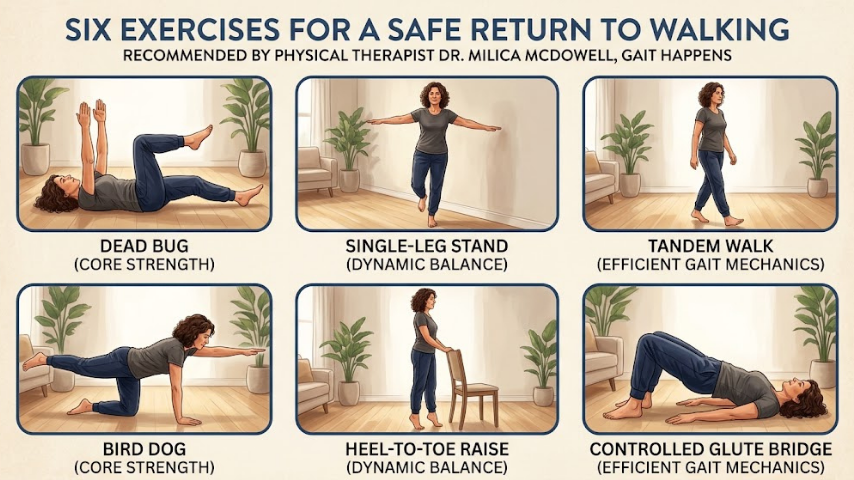
Dr. Milica McDowell, a physical therapist and VP of Operations at Gait Happens, has a different approach. Her argument is simple: build the foundation before you walk, not while you’re walking. Six exercises—done at home, requiring no equipment, taking maybe ten to fifteen minutes — prepare your body for the demands of walking before you put it under those demands.
Here’s what they are, why each one matters, and how to do them correctly.
Why You Need to Prepare Before You Walk
Walking feels simple because we’ve done it automatically for most of our lives. But from a mechanical standpoint, walking is actually a repeated sequence of one-legged balancing acts—you’re never fully stable on two feet at the same time when you’re moving. One foot always leaves the ground while the other supports your entire body weight.
When you’ve been injured or inactive, the muscles and coordination patterns that make this work smoothly start to fade. Glutes weaken. Calf muscles lose their power. Balance becomes less reliable. The big toe—which is the last contact point before your foot leaves the ground — loses strength and stops doing its job properly.
When someone in this state just starts walking without addressing those gaps, the body compensates. You might shuffle instead of striding properly. You might drop your hip on one side. You might hold your torso stiff instead of allowing natural rotation. All of these compensations put stress on joints and tissues in ways they weren’t designed for—and that’s how reinjury happens.
The six exercises below directly address these weaknesses before they become a problem on the pavement.
Exercise 1—Single Leg Swings
What it trains: Dynamic balance and natural gait rhythm
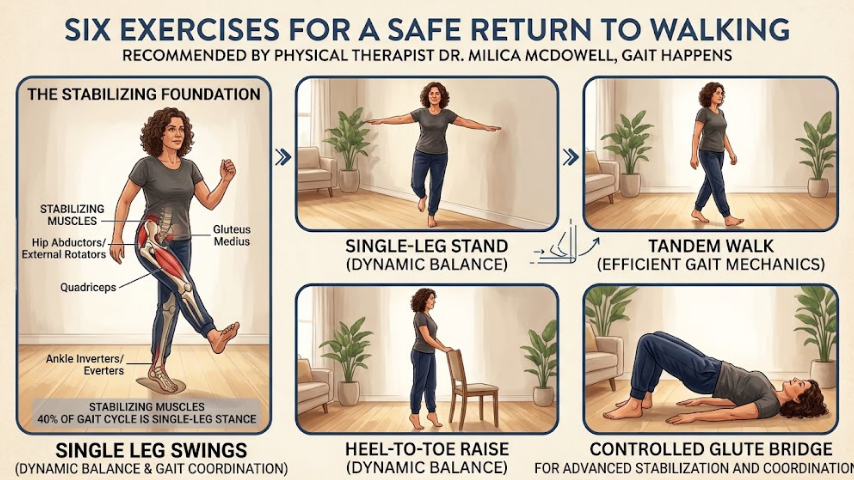
This is the exercise that most directly replicates what walking actually requires. As Dr. McDowell explains, roughly 40% of the walking cycle happens on a single leg. If that single-leg balance isn’t reliable, every stride you take is slightly unstable.
How to do it: Stand near a counter or sturdy surface and place your fingertips lightly on it — not for support, but for reassurance. Swing one leg forward and backward in a relaxed, pendulum-like motion. Let your arms move naturally in the opposite direction, the same way they would when you’re walking. Keep the movement gentle and controlled.
Start with 10 swings on each side. The goal isn’t to swing high — it’s to keep your standing leg stable while the swinging leg moves freely. If your standing foot is shifting around or your torso is swaying, slow down and reduce the range of motion.
Exercise 2 — Sit to Stand
What it trains: Glutes, hamstrings, and core strength for propulsion
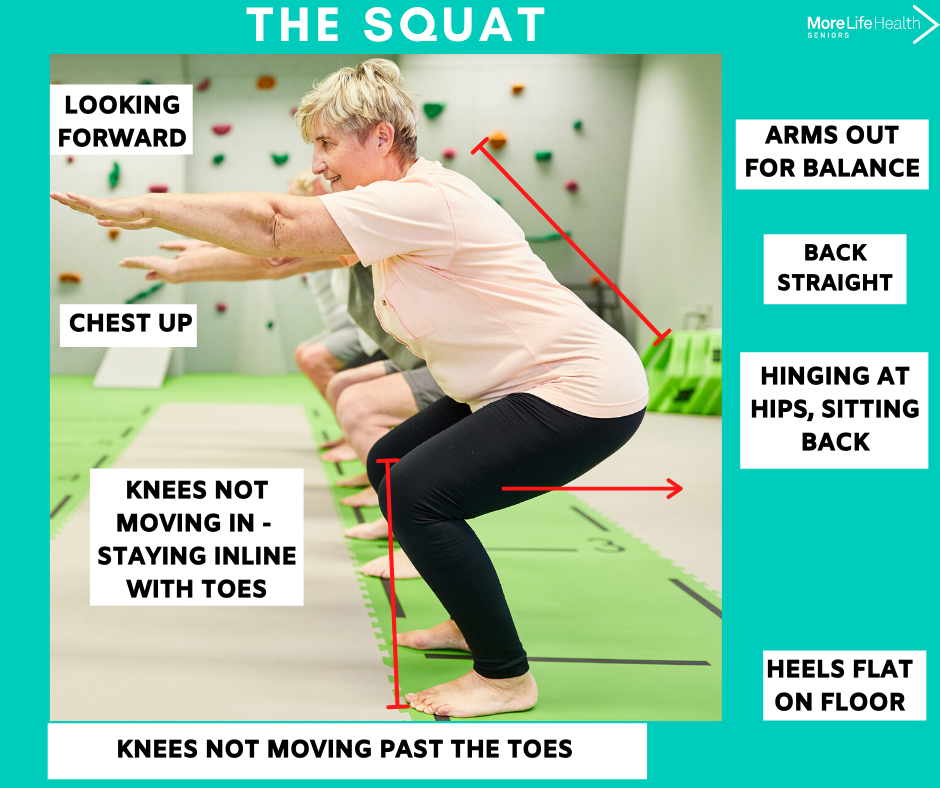
This one looks deceptively simple. Getting up from a chair and sitting back down is something most people don’t think twice about—but done slowly and deliberately, it’s one of the most effective ways to rebuild the lower body strength that walking depends on.
Dr. McDowell specifically calls out the glutes and hamstrings here. These muscles drive you forward with every step. Without adequate strength in them, you shuffle, you fatigue quickly, and your other muscles start compensating in ways they shouldn’t.
How to do it: Sit near the front of a stable chair. Cross your arms across your chest or hold them out in front of you. Lean slightly forward from the hips, then push through your heels to stand fully upright. Pause for a moment at the top. Then slowly lower yourself back down — don’t just drop into the seat. Control the descent.
Start with 10 repetitions. If this feels too difficult, you can use the armrests or a counter for light assistance. If it’s too easy, slow down the lowering phase to make it harder.
Exercise 3 — Calf Raises
What it trains: Push-off power and ankle stability
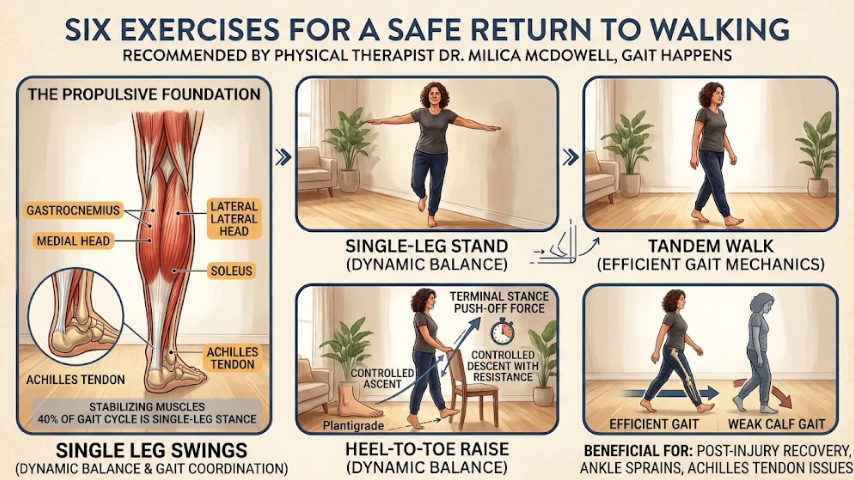
The calves are the engine behind each stride. They generate the force that propels you forward as your back foot leaves the ground—which Dr. McDowell describes as the propulsive phase of walking. Weak calves mean a weak push-off, which means a shuffling, flat-footed gait that’s tiring and inefficient.
After injury or extended rest, calf strength often drops significantly — and it’s one of the slower muscles to recover without targeted work.
How to do it: Stand near a counter with fingertips resting lightly on the surface. Rise up onto the balls of your feet as high as you comfortably can. Hold for two to three seconds at the top — really feel the contraction in the calves. Then lower slowly and with control. Don’t let your heels crash down.
Start with 10 to 15 repetitions. Once this feels easy, try doing them on one leg at a time — which is closer to what actually happens during walking.
Exercise 4—Single Leg Balance
What it trains: Static balance and fall prevention
Where single-leg swings train dynamic balance, this exercise trains static balance — the ability to hold steady on one leg without moving. Both types are needed for safe walking.
The fall prevention angle here is important. Falls during walking almost always happen at the moment of weight transfer — when one foot is coming up and the other is bearing full weight. If that standing leg isn’t stable, that’s when you stumble.
How to do it: Stand near a counter. Shift your weight onto one foot and lift the other slightly off the ground. Find a fixed point on the wall in front of you and focus on it — this significantly helps with balance. Notice your core engaging to keep you upright.
Hold for 20 to 30 seconds, then switch legs. Start with the counter available and use it as needed. Over time, work toward needing less and less contact. Eventually, try doing it with your eyes closed—which removes the visual cue and forces your balance system to work harder.
Exercise 5 — Arm Swings and Torso Twists
What it trains: Gait efficiency and natural movement rhythm
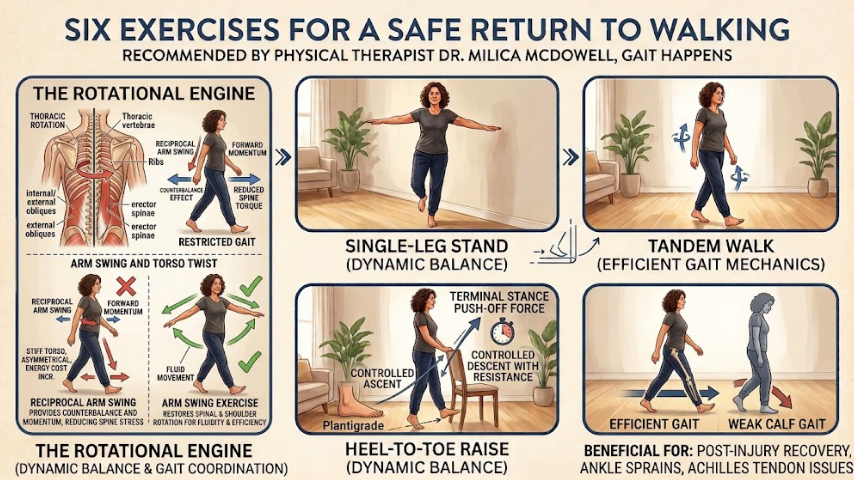
This is the exercise people most often skip because it doesn’t feel like exercise. It looks like you’re just standing there waving your arms. But Dr. McDowell is emphatic about its importance: “Work on unlocking their arm swing and unlocking their torso.”
After injury or a period of inactivity, people often walk with a guarded, stiff upper body. The arms don’t swing properly. The torso doesn’t rotate. What this does is make walking significantly less efficient — and puts more stress on the lower back and hips as they try to compensate for the lack of natural movement above them.
How to do it: Stand comfortably with feet hip-width apart. Let your arms swing freely forward and back, as if you’re walking. Allow your shoulders and torso to rotate gently with the movement — don’t force it, just don’t resist it either. Let the rotation happen naturally.
Do this for 30 to 60 seconds. If your torso feels stiff and reluctant to rotate, that’s information. Stay with it gently. Over several sessions, it will loosen.
Exercise 6 — Big Toe Press
What it trains: Foot stability and fall prevention
This is the exercise most people have never heard of and the one Dr. McDowell is most insistent about. The big toe is the last part of your foot to leave the ground with every single step — and its strength is, as she puts it, “one of the biggest predictors of risk of falls.”
A weak big toe means instability at the final moment of each stride. The body compensates by gripping with the other toes, altering foot mechanics, and eventually changing how the ankle and knee absorb load. Over time, this creates problems well beyond the foot.
How to do it: Start seated. Press just your big toe firmly into the floor, keeping the other four toes relaxed and lifted if possible. Hold for three to five seconds and release. Do 10 repetitions on each foot.
Once this feels comfortable, try it standing — with a counter nearby for balance. You’ll quickly discover how much stabilizing work the big toe actually does when you’re upright. This is one of those exercises where small effort produces noticeable results relatively quickly.
Putting It Together
These six exercises don’t need to be a long production. Done together, they take about 10 to 15 minutes. The sequence makes sense in this order — starting with dynamic movement, building through strength work, and finishing with the fine motor control of the big toe press.
Do this routine daily for at least one to two weeks before resuming regular walks. Once you do start walking, keep doing the routine—it’s useful ongoing maintenance, not just a pre-walking phase.
Start your walks short. Ten minutes on flat ground. See how your body responds over the next 24 hours. If nothing flares up, gradually extend. The goal is a return that lasts — not a heroic first walk followed by a setback.
Conclusion
Returning to walking after injury isn’t just about willpower or pushing through discomfort. It’s about giving your body the specific preparation it needs to handle the demands of walking safely and sustainably.
These six exercises—single-leg swings, sit-to-stand, calf raises, single leg balance, arm swings with torso rotation, and big toe press — address the exact physical requirements of walking. Balance, propulsion, core stability, foot mechanics, and natural movement rhythm. That’s the whole picture.
Do the preparation. Build the foundation. Then walk — with confidence, rather than hope.
Disclaimer
This article is for general informational and educational purposes only and does not constitute medical advice, diagnosis, or treatment. The exercises described are based on recommendations from physical therapist Dr. Milica McDowell and are intended as general guidance for people returning to walking after mild injury or inactivity. They are not a substitute for individualised assessment and treatment from a licensed physical therapist or healthcare provider. If you are recovering from surgery, a significant musculoskeletal injury, neurological condition, or any other medical issue, please consult your doctor or a qualified physiotherapist before beginning any exercise program. Stop any exercise immediately if it causes pain, dizziness, or discomfort and seek medical advice.
FAQ
Sources

Health & Wellness Writer | Research-Informed Health Content Creator
A.K.M. Monjurul Hoque is a health and wellness writer specializing in health, beauty, fitness, nutrition and healthy living. His content is informed by health journals, books, seminars, training programs, and discussions with experienced healthcare professionals. He writes clear, practical and research-informed articles for general education and encourages readers to seek personalized advice from qualified medical professionals.