


Minnesota Is Making Social Media Apps Show a Warning Before You Scroll. Here’s Why.
Starting July 1, 2026, if you open Instagram, TikTok, Snapchat, or any major social media platform while in Minnesota, something new will happen before your feed loads. A pop-up will appear. It’ll flag the potential mental health risks of spending too much time on the app. You’ll have to acknowledge it before you can continue.
It takes a few seconds. That’s the point.
Minnesota has become the first state in the US to pass a law requiring social media platforms to show a mental health warning every single time a user logs in. It’s a small interruption, deliberately designed. The idea is that a brief pause — a moment of actual awareness — might change how people, especially teenagers, engage with these platforms.
Whether it will work is a genuine question. Whether it’s even legal is being contested. But the reason it exists at all is rooted in some deeply painful stories.
What the Warning Actually Does
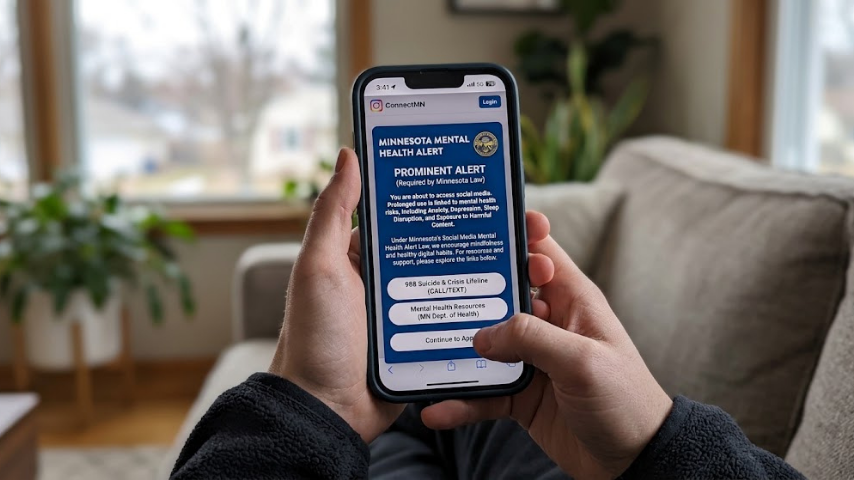
Every time someone in Minnesota opens a covered social media app, a pop-up will appear. The message will outline the potential risks of heavy platform use — things like anxiety, depression, poor sleep, negative body image, and in some cases suicidal thinking, particularly among young people.
The exact wording is being developed by the Minnesota Department of Health, with a deadline of March 1, 2026, to have the guidelines finalized before the law takes effect.
The alerts will also include direct links to support resources. The 988 Suicide and Crisis Lifeline is specifically mentioned — meaning that for any young person in a difficult moment, help is literally one tap away from the screen they’re already on.
State Representative Zack Stephenson, who led the push for the legislation, describes the alerts as similar in spirit to the warnings on cigarette packets or alcohol labels. The comparison is intentional: these products are legal, widely used, and carry real risks — and society has decided that people deserve to know those risks clearly, every time they engage with the product. He’s applying that same logic to social media.
The Research Behind It
This law didn’t come out of nowhere. The research connecting heavy social media use to mental health problems in young people has been building for years.
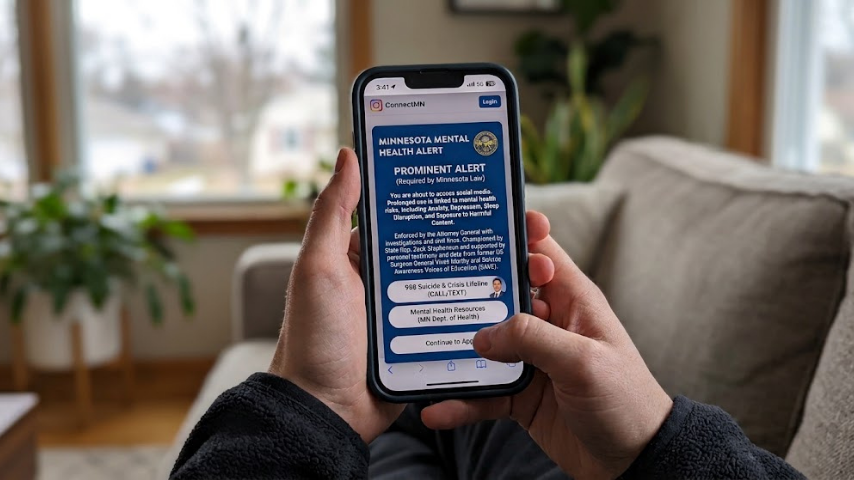
Former US Surgeon General Vivek Murthy has been one of the more prominent voices on this. He has pointed to studies linking excessive screen time in adolescents to eating disorders, disrupted sleep, increased anxiety, and declining emotional health. His warnings drew significant national attention and gave legislators like Stephenson a clear scientific foundation to work from.
The concerns are particularly acute for teenagers. Adolescent brains are still developing, including the parts responsible for impulse control and emotional regulation. Platforms designed to maximize engagement — through notifications, infinite scroll, algorithmic content that keeps getting more extreme to hold attention — interact with those developing brains in ways that researchers are increasingly concerned about.
Erich Mische, who leads the nonprofit Suicide Awareness Voices of Education (SAVE), sees the alerts as an educational tool rather than a restriction. His focus is on making sure young people understand the specific risks that exist in digital spaces — not just mental health impacts, but also exposure to bullying, illegal drug sales, and trafficking. Knowing the risks exists, he argues, is the first step toward navigating them more safely.
The Families Who Pushed for This
Legislation like this rarely passes without people making it personal. In Minnesota, the hearings included testimony that was genuinely hard to hear.
Bridgette Norring lost her son after he bought a lethal substance through Snapchat. She told legislators that a pop-up warning — something that made her son pause for even a moment — might have changed what happened. She also described hearing regularly from teenagers who can’t sleep, who feel anxious constantly, who are worn down by nonstop notifications and the social pressure of being permanently visible online. For her, the link to a crisis line isn’t a small thing. It could be everything.
Tabbatha Urbanski testified about her 17-year-old son, who died from a drug overdose after purchasing the drugs on Snapchat. Her son was 17. The platform was the marketplace.
These stories don’t prove that a warning pop-up would have saved either of those boys. Nothing can prove that. But they do illustrate why parents in this position feel urgently that something — anything — should change. And they help explain why legislators who heard this testimony felt compelled to act.
The Pushback
Not everyone thinks this law is a good idea, and the objections aren’t frivolous.
The primary concern is constitutional. Forcing private companies to display government-written messages on their platforms is, critics argue, a form of compelled speech — which raises serious First Amendment questions. This isn’t a hypothetical concern. Courts have wrestled with compelled speech issues before, and the outcomes aren’t always predictable.
NetChoice, an industry group that represents major tech companies, has called the law government overreach. Their position is that if Minnesota wants to address social media’s mental health impact, the better approach is public education campaigns — not mandating that platforms become delivery mechanisms for state-authored warnings. They’ve signaled they’re prepared to challenge the law legally if efforts to repeal it don’t succeed.
Some legislators who voted against the bill made similar arguments. The debate isn’t really about whether social media has mental health impacts — most people across the political spectrum accept that it does, at least to some degree. The debate is about what governments can and should require private companies to do about it.
What This Means Beyond Minnesota
Minnesota is the first state to pass a law like this, but it almost certainly won’t be the last — either in terms of similar legislation in other states, or in terms of legal battles that could determine whether such laws can stand.
If the law survives legal challenges and the alerts prove effective at even modestly changing how young people engage with platforms, other states will notice. If it gets struck down in court, that outcome will shape what future legislation in this space can look like.
Either way, the conversation Minnesota has forced into the open is one that matters. The question of how social media platforms affect mental health — particularly for teenagers — isn’t going away. And the question of who is responsible for addressing that impact — the platforms, the government, parents, schools, or some combination — is one that society is still working out.
The pop-up warning is a small thing. What it represents is much larger.
Conclusion
Minnesota’s social media mental health alert law is not a ban. It doesn’t restrict access or limit what platforms can show. It just asks for a moment — a few seconds of awareness before the scroll begins.
That might sound modest. But the families who testified in support of it don’t see it as modest. They see it as the kind of thing that might have changed something, if it had existed earlier.
Whether the alerts will reduce anxiety in teenagers, prevent dangerous decisions, or prompt someone in crisis to call a helpline — none of that can be predicted with certainty. What can be said is that the underlying problem is real, the research is real, and the grief of families who’ve lost children to platform-related harms is real.
A pause before the feed loads is a small intervention. Sometimes small interventions matter.
Disclaimer
This article is for general informational and educational purposes only. It is based on publicly available information about Minnesota’s social media mental health alert legislation as of the date of writing. Legislative details, enforcement mechanisms, and legal outcomes may change. This article does not constitute legal advice. The mental health research referenced reflects the current state of scientific literature and ongoing debate; individual responses to social media use vary significantly. If you or someone you know is experiencing a mental health crisis, please contact the 988 Suicide and Crisis Lifeline by calling or texting 988. In an emergency, call 911.
FAQ
What exactly does Minnesota’s new social media law require?
It requires major social media platforms to display a mental health warning pop-up every time a user in Minnesota attempts to access their account. The warning must highlight the potential risks of heavy platform use and include direct links to mental health support resources, including the 988 Suicide and Crisis Lifeline. The specific wording of the alerts will follow guidelines developed by the Minnesota Department of Health.
When does the law take effect?
July 1, 2026. The Minnesota Department of Health has until March 1, 2026, to finalize the guidelines that will govern exactly what the alerts say.
Which platforms are covered by the law?
The law targets major social media platforms. The specific list of covered platforms will be determined by the enforcement guidelines, but the law is clearly aimed at large commercial platforms with significant youth user bases rather than small or niche services.
Sources
| # | Source | Link |
|---|---|---|
| 1 | Minnesota Legislature — HF 3186 Social Media Mental Health Alert Law | https://www.revisor.mn.gov |
| 2 | Minnesota Department of Health — Digital Wellness | https://www.health.state.mn.us |
| 3 | US Surgeon General — Advisory on Social Media and Youth Mental Health | https://www.hhs.gov/surgeongeneral/reports-and-publications/social-media-mental-health/index.html |
| 4 | 988 Suicide and Crisis Lifeline | https://988lifeline.org |
| 5 | Suicide Awareness Voices of Education (SAVE) | https://save.org |
| 6 | NetChoice — Statement on Minnesota Social Media Law | https://netchoice.org |
| 7 | American Psychological Association — Social Media and Youth Mental Health | https://www.apa.org/topics/social-media-internet/health-advisory-adolescent-social-media-use |
| 8 | NIH / PubMed — Social Media Use and Adolescent Mental Health | https://www.ncbi.nlm.nih.gov/pmc/articles/PMC7364393 |
| 9 | CDC — Youth Mental Health and Technology | https://www.cdc.gov/mentalhealth/tools-resources/individuals/index.htm |
| 10 | Star Tribune — Minnesota Social Media Warning Law Coverage | https://www.startribune.com |
| 11 | The Verge — Social Media Mental Health Laws State by State | https://www.theverge.com |
| 12 | First Amendment Coalition — Compelled Speech and Social Media Laws | https://firstamendmentcoalition.org |

Health & Wellness Writer | Research-Informed Health Content Creator
A.K.M. Monjurul Hoque is a health and wellness writer specializing in health, beauty, fitness, nutrition and healthy living. His content is informed by health journals, books, seminars, training programs, and discussions with experienced healthcare professionals. He writes clear, practical and research-informed articles for general education and encourages readers to seek personalized advice from qualified medical professionals.